| |

QUICKFIRE
PRE-DREADNOUGHT ERA FAST-PLAY RULES
|
Combat Chart
Guide
Introduction
This guide helps players to quickly understand how the different parts of the combat chart are used to resolve gunfire, calculate damage effects and
check for sinking. For tables which require die rolling, a note in
the upper right corner will show how many six-sided dice are used to resolve the action. Hence 1D6 means that one six sided die is used for each die
roll, and 2D6 means two six sided dice are used for each roll on that table. Game play requires using two different colors of dice, but the actual colors used are optional. For sake of clarity the rules text always uses black and white dice for its examples. |
 GUNFIRE & HITS GUNFIRE & HITS
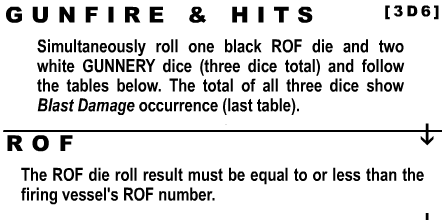
These tables are used to score damage from ship's guns.
Resolve these gunfire hits by rolling three six sided die for each round of fire; one die will be the black ROF die, and two white dice are the Battery Fire dice.
ROF Table – Details
The result of the black ROF die will decide whether the ship fired this turn. If the number rolled is equal to or less than the firing ship's current ROF value, the ship is considered to have fired this turn and the Battery Fire results can be checked for effect. If the ROF number is greater than the current ROF rating for that ship, it has failed to "put enough lead in the air" that turn and is considered not to have fired. This does not mean the ship did not fire at all, just that it did not fire enough to warrant calculating.
|
 Battery Fire Table – Details Battery Fire Table – Details
This table is used if the black ROF die shows that the ship fired.
Start Battery Fire by comparing the attacker's respective Gunnery Rating (heavy or light) against the target vessel's corresponding heavy or light armor Rating (number one). The resulting percentage difference is used to find what die roll is needed to score any hits (number two). Note that Page 2 of the combat chart includes a gunnery reference table to help quickly calculate these percentages.
Scoring Hits: Once you know your percent difference and corresponding die roll number, refer to the total of the two white gunnery dice. If the total is equal to or less than the matching Die Roll number, refer to the corresponding hit result for that line (number three) to see how many hits are scored. Note however, that the number of hits scored relate directly to the white dice result. If a firing ship can score hits on a nine or less (A 9 die roll would cause two hits) and the actual roll result is a 4, that means one hit is scored (directly relating to the 4 die roll result line).
Hit Types: Once the player knows if there was a hit or hits, and what line was involved (as decided by the natural white dice total), cross index over to the type column to find the specific type of hit(s) inflicted
(number
four). Even results will always give Speed (S) Hits, and odd results will always give Gunnery (G) Hits, each corresponding to gunnery ratings that caused it (heavy or light).
Battery Fire Example #1: The French battleship Massena with a heavy gunnery value of 16 is firing on the US battleship Ohio which has a heavy armor value of 11, which is a 125% advantage over the target for the Massena - meaning that the Massena can score a hit if the two white dice total 7 or less (if the ship actually fires, as decided by the black ROF die). The French player rolls a 1 on the ROF die (the ship fires) and a 2 and a 4 on the white gunnery dice. With a gunnery dice total of 6, the Ohio suffers one Speed (S) hit, which is potentially repairable presuming Ohio has any repair dice to work with.
|
 Blast Damage Table – This
table is used to cover low-odds critical hits to external and internal areas
of a ship. Blast Damage Table – This
table is used to cover low-odds critical hits to external and internal areas
of a ship.
Start by totaling all three gunnery dice rolled for the ROF and Battery Fire tables (do not re-roll, use the original die roll that decided the gunnery hits, if any). Take that value and cross reference it with the Range line that matches the current distance between ships. The result Hit Code(s) are applied to the ship as of the end of the current gunnery phase (keeping in mind that all gunnery within a phase is considered simultaneous).
|
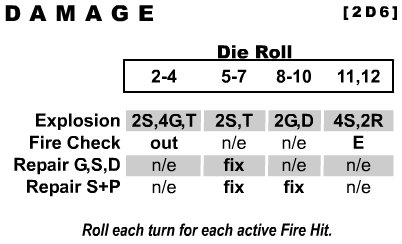
Damage Table – This table decides the effects of existing damage, and the odds of making repairs with Repair dice. Use the table by rolling two six-sided dice and cross-referencing the result (shown under Die Roll) with the line that corresponds to the damage or repair attempt in question. The cross-referenced point will show either a result code or codes, or "n/e" which means no effect. Below are some details for the respective lines:
Explosion: For any E result, roll 2D6 on this line and apply the result codes shown.
Fire Check: Recurring damage test. Roll on this line for each active fire and apply the results: out means that the Fire Hit in question goes out (cross out the fire) and E means the fire has caused an explosion, immediately roll for effects on the Explosion line. An E result does not cause the triggering fire to go out - it remains to possibly cause more problems next turn.
Repair G, S, D: To attempt repair of a Gunnery (ROF), Speed or Direction hit, roll 2D6 on this line. A die result of 5 to 7 results in a repair of that hit. Cross out the hit to restore the previous value, or cross out the Direction hit for the ship to regain course/directional control.
Repair S+P: To attempt repair of a Speed hit (regular S hit) on a ship with +P speed protection, roll 2D6 on this line. A die result of 5 to 10 results in a repair of that hit. Cross out that hit to restore the previous value.
|
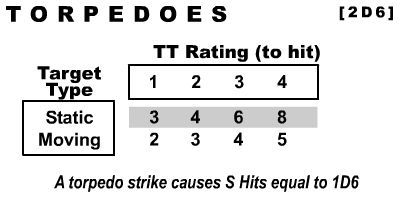
Torpedo Hit Table – Ships which have Torpedo Rating Points and are within point-blank range of enemy ships may roll on this table to see if they successfully launched torpedoes and scored any hits. To do so, cross reference the firing ship's current torpedo point rating with the Target Type which sorts the result by moving versus static (not moving) vessels. Note that a targeted ship which moved one speed box distance (or less) also counts as static (not moving) for purposes of torpedo fire. The cross referenced value is the number that the firing ship must roll equal-to or less-than on two six-sided dice (2D6) to score a torpedo hit.
Game Note: The torpedo rating is not the number of times a ship may fire torpedoes, it represents the overall chance of the firing ship to score one torpedo hit during a turn. If a torpedo hit does occur, the ship's torpedo points are not consumed or reduced because of the hit. The ship may attempt another torpedo launch on following turns if it retains any torpedo ratings points.
S Hit Die Roll - If a torpedo strike is scored, roll 1D6 and that number of Speed Hits to the target's speed table.
Torpedo Hit Example: A destroyer with a torpedo rating of 4 is within point-blank range of a moving enemy capital ship. The destroyer must roll a 5 or less on 2D6 in order to score a torpedo strike. |
 Boat Gun Fire – Any ships with a boat gun capability (shown as a BG icon in the ROF table) and able to fire at light vessels that approach to within point-blank range. Light vessels count as anything Size 1 or smaller, with less than one point of armor rating (i.e., 1/2 point or Zero armor). To fire boat guns, simply roll 1D6 for the firing ship. Boat guns may be used once per gunnery phase, in any direction. Boat Gun Fire – Any ships with a boat gun capability (shown as a BG icon in the ROF table) and able to fire at light vessels that approach to within point-blank range. Light vessels count as anything Size 1 or smaller, with less than one point of armor rating (i.e., 1/2 point or Zero armor). To fire boat guns, simply roll 1D6 for the firing ship. Boat guns may be used once per gunnery phase, in any direction.
Boat Gun Fire Example: A battleship with an active boat gun capability has an enemy destroyer within point-blank range of it. It rolls 1D6 against the one ship and rolls a 5. The destroyer suffers one Torpedo Rating (T) Hit and will mark one point off of its current Torpedo Rating total. |
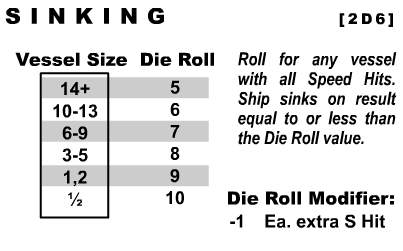 Sinking Table – Ships which are completely stopped due to all eight speed boxes being marked out with Speed Hits must roll on the Sinking table at the end of each turn to see if they sink. Take the size of the ship and refer to the Die Roll number next to it. If the ship rolls equal to or less than the number shown, it sinks and is removed from the playing area. If the ship has suffered additional Speed Hits (beyond the eight which blocked out its existing speed boxes), subtract one point from the die roll for each extra S Hit showing (extra hits should be recorded in the ship log margin). Sinking Table – Ships which are completely stopped due to all eight speed boxes being marked out with Speed Hits must roll on the Sinking table at the end of each turn to see if they sink. Take the size of the ship and refer to the Die Roll number next to it. If the ship rolls equal to or less than the number shown, it sinks and is removed from the playing area. If the ship has suffered additional Speed Hits (beyond the eight which blocked out its existing speed boxes), subtract one point from the die roll for each extra S Hit showing (extra hits should be recorded in the ship log margin).
|
|
|


