« Last Update: August 26, 2026
«
1.0 Introduction
These rules have been designed to
recreate predreadnought era naval battles using any of the most common (and not so common) scales of naval miniatures available. Game play is achieved via a single sheet combat chart, plus a log for tracking
ship condition. There is an emphasis on gunnery and
damage tracking, with some other factors either minimized or left out
altogether to help keep game play moving. For example there are no command rules in the game, players simply
move their ships. The major emphasis is on believable combat results between lines of warships armed with enormous guns.
«
1.1 Game Scales
Advanced Quickfire can be played using any
size or scale of gaming miniatures. Each turn's movement is calibrated to a
fairly low rate of speed, which helps players make best use of more confined
playing areas. The Game Scales table below shows the basic ranges
and measures for both metric and imperial measurement for all five playing
scales that we have organized. The tiny scale is intended for use with
really small models at 1/6000 scale. The small scale is for the more common but still small 1/3000 scale. The medium scale is for the popular 1/2400 and 1/1800 scales. The large column covers the rather larger 1/1500 scale models. And the jumbo column is for those players who like to get down on the floor and fire away with 1/1000 sized models or larger. Players can use any size of models with any game scale they want, so long
as the game results are satisfactory and they have the space to play. I have seen players use 1/2400 models on the Jumbo scale range for extra realism. Each of the three gunnery ranges shown: long, medium and point
blank, have particular characteristics which reflect the conditions at
those distances.
| G A M E S C A L E S |
| |
Tiny Scale
1/6000 |
Small Scale
1/3000 |
Medium Scale
1/2400 - 1/1800 |
Large Scale
1/1500 - 1/1250 |
Jumbo Scale
1/1000+ |
| Feature |
Metric |
Imperial |
Metric |
Imperial |
Metric |
Imperial |
Metric |
Imperial |
Metric |
Imperial |
| Measure Unit |
Millimeter |
Inch |
Millimeter |
Inch |
Millimeter |
Inch |
Centimeter |
Inch |
Centimeter |
Inch |
| One nautical mile |
165 |
6½ |
250 |
10 |
330 |
13 |
50 |
20 |
65 |
26 |
| One Cable (distance)¹ |
16 |
¾ |
25 |
1 |
33 |
1¼ |
5 |
2 |
6.5 |
2½ |
| 1000 Yards |
82 |
3¼ |
123 |
5 |
163 |
6½ |
25 |
9¾ |
32 |
12¾ |
| One kilometer |
89 |
3½ |
135 |
5½ |
178 |
7 |
27 |
10¾ |
35 |
14 |
| Gun Range - Point Blank |
0 - 50 |
0 - 2 |
0 - 75 |
0 - 3 |
0 - 100 |
0 - 4 |
0 - 15 |
0 - 6 |
0 - 20 |
0 - 8 |
| Gun Range - Medium |
50 - 300 |
2 - 12 |
75 - 450 |
3 - 18 |
100 - 600 |
4 - 24 |
15 - 90 |
6 - 36 |
20 - 120 |
8 - 48 |
| Gun Range - Long |
300 - 600 |
12 - 24 |
450 - 900 |
18 - 36 |
600 - 1200 |
24 - 48 |
90 - 180 |
36 - 72 |
120 - 240 |
48 - 96 |
| Torpedo Range |
12 - 50 |
½ - 2 |
20 - 75 |
¾ - 3 |
25 - 100 |
1 - 4 |
4 - 15 |
1 - 6 |
5 - 20 |
2 - 8 |
| 1 turn |
Several Minutes |
¹ One "cable" is one-tenth of a nautical mile. This unit of measure was commonly used by ship's crews to determine distances. When steaming in line-ahead, the common distance between predreadnought capital ships (battleships) was usually about two or three cables.
General scale note: The actual space taken up by the "real" ships on these surface scales is very small. For example, at the small scale using 1/3000 miniatures where a typical battleship is about 1.6" long, the "real" ship at that ground scale would be about 0.05" long, or less than the diameter of one smokestack on the battleship model. Most of the area of a fully based, painted model ship represents open sea, with only a tiny dot at the center actually representing a physical ship presence. |
|
« 1.2 Miniature
Ship Models
Game play requires the use of miniature ship models, many
of which are available at the WTJ Store in digital download form which can be 3D printed locally at any scale. There are also other manufacturers of plastic or cast metal miniatures in various scales, plus the good old-fashioned home built balsa wood models which many people still have entire fleets of (ourselves included).
| DEFINITIONS |
| 1D12 |
One twelve-sided die |
| 2D12 |
Two twelve-sided
dice |
| 3D12 |
Three twelve-sided dice |
| ROF |
Rate of
Fire |
| LOS |
Line of Sight |
Miniatures and Bases - Ship models may be
mounted on bases for ease of handling (many players paint ocean texture on the base-top
for added realism). For purposes of game play, the term vessel, model or
ship refers to the
physical model, not the edges of the base it is
mounted on. For purposes of movement, it doesn't matter so long as players measure
movement from the same point on the ship or its base. For
purposes of gunnery and torpedo fire, measurement of distance between two ships is taken between
their forward funnels.
« 1.3
Equipment
The standard gaming equipment of tape measures, twelve-sided
dice and pencils are definitely required. Players will also want to download
the Advanced Quickfire Combat Chart and Ship Log, both of which are available on the
Quickfire home page.
Combat Chart — The combat chart is
made up of tables which allow players to assign damage to ships during a
battle. Any tables used for resolving combat are described in greater detail
below.
Ship Log — The sheet used to track the
condition of warships during a battle is called the Ship Log, which is filled out using the Ship Values pages linked on the Quickfire home page. The log can be downloaded free on the Quickfire home page, including a PDF version set-up for text entry and printing. Each ship log
sheet has entries for six warships, with each log showing the vessel's name, ship size,
gunnery rating, armor rating, torpedo rating, boat guns, rate-of-fire (ROF) values, speed and
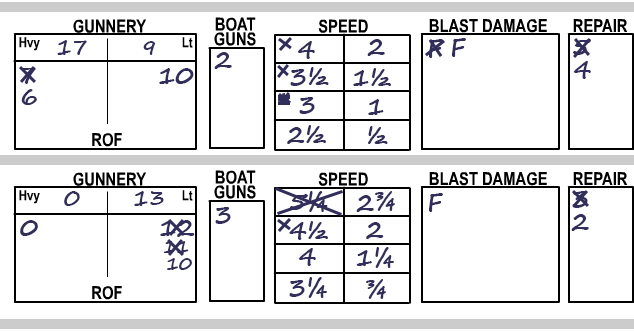
repair points. It also has an extra box for entering blast hit effects. At left is a sample figure of the editable sections of two ship logs and how
they might appear during a battle. Note the following details about the
log:
Upper log: The Gunnery entry shows the ship's Heavy and Light Gunnery Ratings of 17 and 9 respectively. The ROF boxes initially contains only that ship's 7 and 10 ratings for Heavy and Light gunnery (it is probably a battleship).
It has suffered a G Hit that lowered its Heavy ROF rating by one-point. The ship has also suffered three Speed (S) Hits which affected its available movement (currently 3 inches). One of those S Hits has been repaired, note that it is scribbled out, leaving two active speed hits which appear as small X marks. The ship has also suffered two Blast Damage Hits which
started fires, one of which has gone out. At some point the ship used one
Repair Point to make a successful repair die roll, this was likely the repair of the speed hit.
Lower log: The Gunnery entry shows the ship's Heavy and Light Gunnery Ratings of 0 and 13 respectively. The ROF box initially contained only that ship's 0 and 12 ratings (it is probably a cruiser). It has received two Light Gunnery (G) Hits which lowered the Light ROF Rating by two points to a 10. The ship has also suffered one standard Speed Hit and one Unrepairable Speed (SX) Hit - probably from a torpedo strike, leaving its available speed as 4½ inches.
This figure does not include the left side of
the ship log which contains standard ship information such as name, size, and armor which do not change during the game. The ship's Torpedo Rating is also shown at the left side of the log, and that is subject to damage and change in the same manner as the other values noted above. See the Ship Values pages for more information.
«
1.4 Turn Sequence
Once all players have filled out
their ship logs and laid their fleets out, game play is ready to begin. The
game follows a turn sequence which is repeated until both sides agree to stop
the game, one side admits defeat and moves away or if all of one side's ships
are sunk.
1) Conduct Movement — Both sides move their
ships. All movement is conducted simultaneously, and players must avoid
watching other players move first before then moving their own vessels. An
alternative is to roll dice, with the high roller moving first.
This may be done once at the start of the game or at the start of each
turn.
2) First Gunnery — Both sides declare targets and resolve
gunnery. The same side should always resolve gunnery first in order to speed
game play. All damage within this phase is consider simultaneous, so the order
in which gunnery is resolved does not give any advantage. Damage inflicted
during this gunnery phase becomes effective at the end of this phase (phase two) and before
the start of phase three. This means that any losses suffered during the
first gunnery phase reduces ship effectiveness for the second gunnery and
torpedo phase (phase three).
3) Second Gunnery & Torpedo Fire
— Ships which failed the ROF die roll in the first gunnery round may attempt to fire again, with both sides declaring targets and resolving gunnery in the same way. Any torpedo attacks are then resolved in the same manner. As with Phase 2, all damage
- both gunnery and torpedo - within this phase is also considered simultaneous. Note that torpedo fire may
only occur in this phase. Remember that any
damage which occurred in the previous gunnery phase will have taken effect before starting this phase. Ships which successfully fired in the first gunnery round (i.e., passed the ROF roll) may not fire in this round, even if they only failed to score on the gunnery die roll.
4) Recurring Hits — All ships with fires burning on board (Active F Hits) must roll for automatic
fire effects on the Damage table. If the fire goes out (the "out" result), cross-out or erase the "F" mark in that ship's Blast Hits box. If there are explosions, resolve their results immediately. All ships with any SX Hits must roll for additional SX Hit occurrence on the Damage Table. On a roll of 12, add another unrepairable speed hit (SX Hit) to that ship's speed boxes.
5) Repair Attempts — Players may attempt repairs to their
vessels by rolling on the Damage table. See 4.2 Damage Repair.
6) Check for Sinking — Any ships with two or more SX Hits must roll for sinking on the Sinking table. See 4.3 Sinking.
« 2.0
MOVEMENT
The maximum distance a ship may move each turn is limited by
the number shown in the topmost undamaged speed box on that vessel's ship log
(Crossed out speed boxes do not count toward available speed). A ship may move
less than the maximum available, and it may change its speed (distance moved)
depending on the amount it moved on the previous turn. The distance moved
should be measured from the front edge of the ship using a tape measure or
scale. Ships may move through each other but may not end their move
"stacked" or otherwise occupying the same space unless forced by involuntary
conditions (Example: Vessel with a D Hit passing through a ship with zero
movement, etc.). In such cases, the moving ship should stop slightly short of being on top of the other model, but can remain with bases (if any) overlapping. Models mounted on bases may end their turn with the bases slightly and temporarily overlapping, but that should be a passing condition that is not taken to excess.
| Maximum Turn Angles (Listed by Speed box) |
| Eighth Box - 45° |
Fourth Box - 90° |
| Seventh Box - 90° |
Third Box - 45° |
| Sixth Box - 90° |
Second Box - 45° |
| Fifth Box - 90° |
First Box - 0° |
« 2.1 Turning
In
Quickfire, a ship turns by pivoting on its center-point and then moving in the
new direction. The maximum angle a ship may pivot at any one time
corresponds to the speed box that the vessel is currently using. See the figure
at right, which duplicates the layout of a typical ship's speed table, with
maximum turn angles replacing the levels of speed to which they correspond.
A ship may turn up to two times during each movement phase; the first move pivot is free (costs no movement), the second move pivot costs one movement box worth of available movement for that turn (do not mark off the box). Two move pivots in one turn must be separated by at least one move increment (The distance shown in the First Box). The available turn angle as permitted at the start of the move remains in force regardless of turn-induced speed loss.
Example: Using the Medium scale, the British battleship HMS Hannibal has an
original maximum speed of 6-inches. Using the eighth speed box (top-left on
ship log which would be showing 6.0"), she can turn a maximum of 45° once for free during any one
turn. If she turns twice, her maximum distance moved will be 5¼-inch and the two turn pivots should be separated by ¾-inch of movement. If she moves 3-inches (using her fourth speed box) she would be able to turn
90° during any one pivot. If for some reason her speed for the turn is
using her first speed box (bottom-right on ship log which would be showing ¾-inch) her maximum
turn would be 0°, meaning that she does not have enough steerageway to make normal turns.
« 2.2 Changing Speed
During each movement phase, vessels may voluntarily change their previous
Actual Speed by the equivalent of three boxes worth of movement. The
actual speed is the amount of movement used by any one vessel on its
previous turn. This contrasts with maximum Available Speed, which is the
highest general speed available to that vessel according to its current highest
speed rating.
Involuntary speed reduction - Vessels which suffer
multiple speed hits during their turn may be forced to reduce actual speed by
more than two boxes. This is an involuntary speed change and does not violate
the voluntary speed change rule noted above. Note that vessels following a ship
which has suddenly lost speed may be forced to turn suddenly due to their
inability to voluntarily change speed to match the ship to their
front.
« 3.0 GUNNERY
Gunfire is
conducted by rolling one black and one white twelve-sided Firing Dice (two dice
total) and consulting the Gunfire & Hits tables in the combat chart. The
black die is always considered the ROF Die, and white dice are always
considered the Gunnery dice. Actual dice used can be any colors, but for clarity, the ROF and Gunnery dice are always
referred to in the rules as the black and white dice. To conduct gunnery,
follow these steps:
1) Take note of the firing ship's ROF Rating, it is
the number needed on the black ROF die.
2) Declare the firing ship's target
and the Gunnery Rating (Heavy, Light or both) to be used against it.
3) Compare
the firing ship's Gunnery Rating to the target's corresponding Armor Rating and
establish the percentage difference between the two.
4) Roll both
firing dice and establish: a) Whether the ROF die result let the ship fire per the ROF table and; b) Whether the
Gunnery dice resulted in any G or S hits on the Battery Fire Table.
5) Record the resulting hit(s) in
the ship's log and total the values of both dice to see if any Blast
Damage occurred.
6) If any Blast Damage did occur, record it in the Blast
Damage box in the ship's log and/or immediately resolve the damage in the Damage
Table.
Ranges — All gunnery takes place within one
of three range categories: Long, Medium and Point Blank. At long range, only the Heavy Gunnery Rating can be used. At Medium range, both Heavy and Light Gunnery Ratings can be used. At point blank range, all gunnery-based weapons including boat guns may fire. The potency of the various Blast Damage levels also increases as ranges shorten. See the Game Scales table above for specific ranges listed by
game scale.
ROF Rating — Every vessel has
Rate of Fire ratings (called ROF ratings) which reflect the ship's overall
volume of fire relative to other ships on the field. This volume of fire is
affected by the number of guns, their size and their loading systems. Each ship
has two ROF ratings: one relating to its Heavy Gunnery Rating and one relating
to its Light Gunnery Rating (see Gunnery Ratings belows). During the Gunnery
phase, a ship must roll a number on the ROF die equal to or less than its
current ROF Rating for that gunnery type. If the number is greater than the
current ROF Rating for that ship, it has failed to "put enough lead in the air"
that turn and is considered not to have fired. This does not mean the ship did
not fire at all, just that it did not fire enough to warrant calculating. Ships
with numerous quickfiring guns begin the game with very high ROF values. Ships
with lesser numbers of slow loading guns will tend to begin the game with
lower ROF ratings.
ROF Die Roll Modifiers
Missed last ROF roll - Subtract one (-1) from the die roll if the ship's last ROF roll failed to let the ship fire. Applies either to attempts made this turn or on the previous turn (i.e., maximum benefit for this modifier is -1).
Gunnery Rating — Most vessels have two
gunnery ratings; one for the Heavy Fire of its main guns (whatever those might be), and another for the Light Fire of secondary guns between roughly 4" and 8" in size. In the case of a ship with a gunnery rating of zero, it cannot conduct that level of fire (most destroyers have no Gunnery ability for use on the Battery Fire table and instead only have a single Boat Gun). Here are how the different game ranges affect battery fire:
Long Range: A ship firing into the long range bracket may only use its Heavy Gunnery Rating to resolve battery fire.
Medium Range: A ship firing into the medium range bracket may fire both its Heavy and Light Gunnery Ratings, with the Heavy Gunnery Rating counting against the Heavy Armor of the target, and the Light Gunnery Rating counting against the Light Armor of the target. Ships may fire their heavy and light gunnery at two different targets, or both at one target. The recommended method is for the Heavy and Light Gunnery to be resolved as two different die rolls, although players can also resolve both attacks off of a single die roll. This tends to give "mirror" results that lack variety.
Point-Blank Range: As with medium range, both Heavy and Light Gunnery may take place. Boat guns may also be used at point-blank range, but only within the target size limits imposed by the rules. Boat guns cannot fire beyond point-blank range.
Heavy fire is not allowed
against vessels Size 1 or smaller which moved more than half of their own speed boxes worth of distance during their turn.
Even-numbered
Gunnery Dice results always inflict Speed (S) Hits and odd-numbered Gunnery Dice
results always inflict Gunnery (G) Hits. Gunnery Die totals must
always fall within the die roll ranges shown under the Number of Hits columns on the Battery Fire Table.
Battery Fire Table — To score gunnery hits, use the Battery Fire table to
compare the firing ship's gunnery rating against the target ship's armor rating. Take the resulting percentage difference
and match it to the corresponding line on the table. Note that the lines are for percentages which are equal-to or
greater than the gun/armor differentials. If a gun/armor differential is 98%,
that counts as being on the 75% line. The second page of the combat chart has a gunnery reference table that helps to quickly show the percentage for many middle-range Gun/Armor pairings that might otherwise be difficult to quickly calculate during a hectic game.
The Die Roll ranges shown on
each line of the Battery Fire table correspond to the Number of Hits shown at the top of the field. If the white die result falls within any of those ranges, one, two or three G and/or S Hits are scored. Even-numbered gunnery dice results always
inflict S Hits first and alternate onward and odd-numbered dice results always inflict G
Hits first and alternative onward from there. If the white die result falls above (outside) the hit ranges listed, no hits are inflicted.
Example: A ship with a Heavy Gunnery value of 18 fires on a target with 12 armor points. The attacker will use the 150 line (meaning 150%), which needs to roll a 1 though 5 on the die to score one hit, or a 6 through 10 to score two hits.. If the player rolls an 8, they will score the two hits, with the first hit being an S Hit, and therefore the second hit being a G Hit. If they roll a 5, a single G Hit would be scored. The alternating of hits only really matters when three hits are scored; in such cases players will see two of one hit type and one of the other type scored (G,S,G, or S,G,S).
Heavy Gunnery Bonuses — Heavy gunnery receives a few bonuses that let them operate outside the default Battery Fire system of heavy vs heavy and light vs light. At long range, Heavy Gunnery may fire on either Heavy or Light Armor target ratings. This is limited strictly to long range fire. At Point Blank Range, Heavy Gunnery gains a one line bump upward on the Battery Fire Table, so for example, if it engages a ship at 150% at point blank range, it rolls the die for results on the 200% line. Also, if all Speed boxes are filled-in with hits (S or SX), Heavy Gunnery S Hits will automatically convert to SX hits.
Blast Damage Table — To use the blast damage
table, total both dice results from the same Gunnery Roll and cross-reference them to the appropriate
Long, Medium or Point Blank range lines (each range has different damage effects). If the two-dice total matches a Damage Code, apply the respective hit(s) to the ship's log or resolve it immediately via
additional die rolls as required. Blast damage
can happen only if the ship actually fired and scored hits of either type.
Gunnery Examples — Refer to the following examples for
outlines of the gunnery process. Firing Dice results are always called out in the
order "Black, White." So for example, a fire die result of 4,1 would
be a black die roll of "4" and white die roll of "1".
Example: The Japanese battleship Mikasa is
conducting long range Heavy Fire at the Russian battleship Borodino. The Mikasa
player's fire die roll is 5, 8. The black die roll of 5 means that the
Mikasa did fire this turn because its heavy ROF rating is a 7 and it rolled equal-to or less-than that number. The Mikasa's
heavy gunnery rating is a 20 and the Borodino's heavy armor rating is a 10. This
means that the Mikasa is using the 200% Gun/Armor column, with any die results between 5 and 9 resulting in two hits, so Mikasa scores two hits; the first is an S Hit (because of the 8 being an even number) and the second hit alternates to a G Hit. Had Mikasa rolled
a 5, 11, she would have scored two G Hits and one S Hit on the Borodino. Her die results were too high to score any Blast Damage hits.
Boat Guns - Boat guns are very light cannon which are designed to engage destroyers and torpedo boats (and maybe tiny gunboats). Boat Gun fire can only be done within the Point-Blank range bracket, and boat guns can only fire upon Size 1 vessels or smaller which are unarmored (half-point armor rating). Any ships with a Boat Gun Rating may use each rating point to conduct one Boat Gun Attack by rolling 1D12 on the Boat Guns table on the Combat Chart. The types of damage inflicted on the table are the same types used elsewhere in the game. Players may use their boat gun attacks against viable targets in any direction, and in any combination so long as they resolve their entire attack all at once and do not exceed their allowed attack total. If when making a multiple dice attack against a single target (within the gunnery phase), the attacking player rolls all the same dice numbers (doubles, triples, etc.), an Explosion happens on the targeted ship which should be resolved immediately. Note that players must resolve their entire attack on each target all at once. They cannot (for example) conduct one attack on Destroyer A with two dice, and then if they still have two unfired boat gun dice, make another attack immediately afterward with the other two dice within the same phase (which would be gaming the rule to achieve more explosions). In games with no light vessels present, players should still record their Boat Gun Ratings in the Ship Log, because they serve to absorb damage that might otherwise affect other parts of the ship.
« 3.1 Targeting
At Long Range, vessels may
only fire at one target during each gunnery phase. At Medium Range - where both Light and Heavy Gunnery can be used - a ship may use its Heavy Gunnery against one target and its Light Gunnery at a different target (or both at one target). A ship may fire at targets different than those it
fired upon in previous turns. These same limits and allowances apply to Point-Blank Range. Each gunnery and torpedo target must be declared before any
firing is resolved. Players may verbally declare targets, use pointers or chits to assign targets.
Line of
Sight — Vessels may only fire upon targets which are within their
direct line-of-sight. Line-of-sight is drawn from the forward smokestack of a
firing vessel to the forward smokestack of a target vessel. The potential
target may not be fired upon if line-of-sight is directly blocked by other
vessels or land.
Arcs-of-Fire — Most ships concentrate
their greatest firepower in a 90° arc centered on each broadside. Within
this arc, ships fire using their full ROF rating. In the remaining 90° arcs
to the front and rear (fore and aft) of a ship, all ROF ratings are halved
rounding down. In some special circumstances a ship's weapon performance may
not match this average rule. In such cases, like those of citadel type vessels,
the ship values section should note the differences and how they should be
treated for game play. The main Quickfire page includes a sheet of simple
firing arcs to help players establish valid arcs of fire.
«
3.2 Torpedoes
During the second fire phase, a ship
which is within torpedo range of any enemy ships may attempt to conduct a torpedo attack. Torpedo attacks are not mandatory, but as with gunnery all torpedo targets must be declared before die
rolling begins. The arc-of-fire for torpedo attacks is a 270 degree arc centered on the bow of the ship. Players may use the 90-degree arc-of-fire held over the stern of the ship to decide borderline cases, although due to the already generous shooting arc, any close decisions should choose against being able to fire at marginally positioned targets. Unlike gunnery, torpedoes have a minimum range within which
they may not be used.
Each vessel may only conduct a torpedo attack against one target ship per turn (each attack is not necessarily a single torpedo launch, but more of a general effort to hit the target). Note that a
ship's torpedo reload rating may be reduced as the vessel suffers
damage, either due to gunnery hits, blast damage or explosions. Ships may attempt torpedo fire once each turn until they
run out of torpedoes as decided by the Torpedo table results.
Roll to Hit - To attempt a torpedo attack, make sure the launching ship and its prospective target are within effective torpedo range. Then roll two twelve-sided Hit Dice (2D12); one black Hit Die and one white Damage Die. Modify the black Hit Die with any applicable die roll modifiers. A torpedo strike happens on any modified result of 1 or less.
Torpedo Hit Die Roll Modifiers
Converging Target - Subtract one (-1) from the die roll if the courses of the firing ship and the target ship are converging (moving toward each other in any way). Even "almost parallel" courses in which the two ships are aligned slightly away from each other are not converging.
Static Target - Subtract one (-1) from the die roll if the target ship is not moving. A target ship is considered moving if it used two or more speed
boxes worth of movement during the current game turn.
Destroyer/TB Firing -
Subtract one (-1) from the die roll if the firing ship (boat) is a destroyer or torpedo boat. If small enough and fast enough, torpedo gunboats may count.
Torpedo Damage Roll - If the Roll to Hit scored a torpedo strike, add the white die result with the natural black die result (i.e., without modifiers). The total of these two is the
number of damage points to be used to calculate the number of Unrepairable Speed (SX) Hits suffered by the target ship. The size of the torpedo controls how many hits are inflicted by the damage point pool: For 14" torpedoes, inflict one SX Hit per 10 damage points. For 15" torpedoes inflict one SX hit per 7 damage points. For 18" torpedoes inflict one SX hit per 3 damage points. For 21" torpedoes inflict one SX hit per 2 damage points. Hits which fail to accumlate enough points to score damage have no effect.
See the Combat Chart Guide for more about using this table.
Out of Torpedoes - If a hit is scored, compare the natural Damage Die result to the launching ship's Reload Rating. If the natural die roll is equal to or greater than the vessel's Torpedo Reload Rating, the ship has run out of spare torpedoes - cross out the entire Torpedo line, the ship may conduct no further torpedo attacks. This means that vessels who start the game with very high reload ratings like 11 are considered to carry numerous reloads for numerous launch tubes, and vessels with lower ratings are considered to carry few or no reloads for fewer launch tube sets. Hits which fail to score damage are still considered hits and must roll for torpedo depletion.
« 4.0
DAMAGE
As a ship suffers damage during the game, players will mark it
on the ship log according to the type of damage inflicted. It is usually best
to mark damage as a single slash until after both sides have fired, then fully
cross out existing slash marks to show full loss. In cases where boxes –
such as speed boxes – are marked off, this method works especially well, where players can mark small Xs next to the speed values.
In cases where damage is the result of Blast Damage, players might not mark off a
box, they may instead need to mark the blast damage code in the Blast Hits box
on the ship log. This will happen with such damage codes as F (fire) and D
(direction hit). It will usually be obvious whether the player should add a code to the blast damage box
or simply cross something out.
« 4.1 Damage
Types
Most of the Quickfire combat chart tables contain
abbreviation codes for battle damage. Each
of these damage codes tracks a very specific damage type. The glossary below
offers definitions of all damage codes. Immediately following are guidelines
for recording the various damage types. If a certain type of damage is called
for on a vessel and there is no feature of that type on board, then the hit is
counted as no effect unless otherwise called for by the nature of the
hit in question.
| Damage Code Glossary |
| B |
Boat Gun |
Mark one Boat Gun point off of the ship's current available points for each B Hit. If the Boat Gun Rating is zero (either due to damage or the ship never having any boat guns) a Torpedo Reload (T) Hit is inflicted instead. |
| D |
Direction |
Impairs a ship's ability to pivot (turn). When a D Hit occurs, roll another 1D12 and
note the results below in the vessel's Blast Damage box:
1 = May not pivot next game turn (temporary damage, no repair roll needed). Erase hit after next turn.
2 = Course jammed to 90°
Left
3,4,5 = Course jammed to 45° Left
6,7 = Course locked amidships. May not pivot (turn) until repaired.
8, 9,10 = Course jammed to 45° Right
11= Course jammed to 90° Right
12 = DX hit, ability to turn is destroyed (see DX hits below).
For cases of Left and Right course jams, the ship will continue to turn in that manner up to its maximum allowance of two pivots per turn, speed permitting unless/until repaired.
Direction damage from results 2 through 11 can be repaired
during the Repair Phase of the game by rolling a three through seven (3 - 7) on the repair dice. A D Hit scored on a currently unrepaired (active) D Hit turns the current state of both to a DX Hit, update the ship log accordingly. |
| DX |
Unrepairable Direction Hit |
Steering gear is completely disabled or destroyed. Not repairable. Ship may not make any further pivots (turns) for the remainder of the game. Additional DX Hits after the first one become SX Hits. |
| E |
Explosion |
Go to the Explosion line of the Damage
table and roll 1D12. Apply resulting damage hits to the vessel. Gunnery (G) Hits caused by
explosions are removed equally from the Heavy and Light ROF
Ratings, unless one ROF is already at zero, . |
| F |
Fire Hit |
Mark an "F" in the
Blast Damage box of that vessel's ship log to show that it has suffered a Fire (F) Hit. Each turn that a fire burns, the
player must roll on the Damage Table to see if it has burned out (shown as out), caused
a Boat Gun (B) Hit, caused an Explosion (E) or continues burning (shown as n/e). The F Hit die-roll test is done just before the end of each turn, see Turn Sequence for more information. |
| fix |
Damage Repaired |
The Gunnery, Boat, Direction, Speed or Speed+P hit in question is repaired.
Erase the damage from the log (or cross it out) and reapply the previously lost ROF, Boat Gun or Speed
rating. If successfully repairing a Direction hit, the ship may resume normal directional control starting on the following turn. |
| G |
Gunnery
Hit |
Mark off one ROF
Rating point from the ROF box on the vessel's ship log according to the following
rules:
Each G Hit caused by Heavy Fire reduces the target vessel's
Heavy ROF rating by one point. If the target vessel's Heavy ROF Rating is at zero, a Light ROF Hit is inflicted instead. If all ROF points are at zero, a Boat Gun (B) Hit is inflicted instead. If the ship was firing at long range against the target ship's Light Armor rating, apply the resulting G Hit to the Light ROF rating.
Each G Hit caused by Light Gunnery reduces
the target vessel's Light ROF rating by one point. If the target vessel's Light
ROF rating is at zero, a Boat Gun (B) Hit is inflicted instead.
Gunnery (G) Hits caused by
explosions are removed equally from the Heavy and Light ROF
Ratings, unless one of those ROFs is zero (for any reason). As with other G Hits, if there are no available ROF points to reduce, these hits will progressively convert to the next available: B, T, R or F hits (F hits can always be inflicted, there is no limit to how much a ship can burn). |
| out |
Fire
Extinguished |
The fire in question has either burned
itself out or been extinguished. Note that players may not specifically attempt
to extinguish a fire using their repair die rolls, it can only happen as part of the F Hit status check.. |
| R |
Repair
Hit |
Mark off one Repair
(R) Point from the Repair box on the vessel's ship log. If no
repair dice points remain, this hit becomes an F Hit. |
| S |
Speed Hit, Repairable |
Check off one speed box in the ship's
log starting with the upper left eighth-box first, usually by marking a small "x" in one corner of the box, so that it can be scribbled-out if repaired. Repairable speed hits (those not caused by torpedo hits, explosions, etc.) may be repaired on a repair roll result of 3 through 7 using 1D12.
See the Damage Repair section below.
If all of a ship's speed boxes are marked off by repairable speed hits (or a combination of unrepairable and repairable hits) and it suffers additional S Hits due to Heavy Gunnery, those hits transform to SX Hits and are applied accordingly. If the extra S Hits are from Light Gunnery, those hits transform to Fire Hits. |
| SX |
Speed Hit,
Unrepairable |
Unrepairable speed hits (SX Hits) are applied in the same manner as regular S Hits, but they are - as the title states - not repairable and are shown by completely crossing out affected boxes. If the ship already has repairable speed hits, migrate those downward to make room for the permanently crossed out boxes which should be placed in sequence starting at the top-left of the ship's speed table. If the ship's speed boxes are full of SX Hits and it suffers more (and has not sunk yet), mark the extras in the margins around the speed box, those extra SX hits act as a die roll modifier toward making the ship sink.
Note that any SX hits present on a ship trigger a recurring damage check (single die roll) every turn to see if another SX Hit is triggered (e.g., flooding). The number of SX Hits already present does not matter, any number of hits triggers the one recurring die roll check. |
| T |
Torpedo Reload Hit |
The Torpedo Reload Hit represents damage to the vessel's reload rating for torpedo tubes, torpedo crew and the torpedoes stored on-board. Subtract three points
from the vessel's Torpedo Reload Rating for each T Hit. Torpedo reload hits cannot be repaired, and if the rating is reduced to zero, cross out the ship's entire Torpedo line - it can no longer try to fire torpedoes. If the ship's Torpedo Reload Rating has been reduced to zero and another T Hit is scored, a Repair (R) Hit is inflicted instead. Note that every Torpedo Reload Hit - even if it happens to a ship whose torpedo reload points have all been lost - must still check for a Fire hit by rolling on the Damage table as a one-time check (T hits do not trigger recurring tests like fires do). T-hits and their side effects do not apply to ships which had no torpedoes to begin with. |
| |
|
|
« 4.2 Damage
Repair
Each turn after active fires and SX hits have been checked (See Turn Sequence), players may attempt to repair Gunnery, Speed, Direction and Boat Gun hits. The ship's repair rating listed in the ship log's Repair box shows how many repair dice a player has available to use. A repair roll is conducted by rolling one twelve-sided die (1D12) and referring to the Damage table on the combat chart.
Repair rolls that do not succeed in making an actual repair may be kept and reused on future turns (e.g., a failed attempt does not reduce the ship's repair point total). A repair roll which succeeds in making a repair is "used up," and the current repair point total for that ship is reduced by one. A player may use one repair die roll attempt against each damage point type, each turn. For example, if a ship has suffered three Light Gunnery hits, one repair die roll attempt on that Gunnery Rating may be made that repair phase. So in theory, if a ship takes one each Heavy Gunnery Hit, Light Gunnery Hit, Speed Hit and Boat Gun Hit, the player could be allowed to roll four repair dice that turn. Ships may not transfer repair points to other ships or conduct repairs on their behalf.
S+P Repair - Vessels listed in the Ship Values page with a "+P" after their speed code have unusually good waterline Protection which allows them to avoid or delay severe flooding problems that would otherwise slow and endanger the ship. This status is shown on the ship log as a "+P" next to the "SPEED" header (SPEED+P). Ships with this code can use the S+P repair line, which makes the repair of Speed hits much more likely. Ships without this code must use the regular "Repair S" line on the damage table. As with regular ships, those with Speed+P capability cannot repair SX Hits caused by torpedoes or explosions.
« 4.3
Sinking
Any vessel that has suffered two or more unrepairable speed hits (SX hits) is considered at some risk of sinking. At the end of each turn, roll one twelve-sided die (1D12) for
each vessel with the two or more hits, applying the die roll modifier if necessary. If
the modified result is equal to or less than the value shown in the Die Roll
column for a vessel the corresponding number of SX Hits, that ship has sunk and
is removed from the board.
Sinking Modifier
Extra SX Hits - Subtract one (−1) from the sinking die roll for each SX hit beyond the eight speed boxes. Extra hits are recorded in the margin of the speed track after all eight boxes have been crossed out as SX. This modifier cannot apply until the ship has over eight SX hits. A ship with eight or fewer SX hits will always roll against its current SX row with no modifier.
End of Turn — Once all damage and sinking tests
are completed, the turn in complete. If the game is to continue, players now
begin a new turn by conducting a new movement phase.
|