 «
100 BC ALPHA «
100 BC ALPHA
Updated April 18, 2025.
Please note that this alpha rules text is currently for guidance as a reference to those using the combat chart. The text itself has been adapted from a related WTJ rule set and there may be some remaining text referring to those other periods. Such text will gradually be phased out as we increasingly focus the rules on the various aspects of warfare in antiquity.
«
1 INTRODUCTION
100 BC is being
designed to recreate battles of antiquity, covering the periods of roughly 1200 BC to 400 AD, with the best
possible combination of play time and convincing results. The rules will be focused on ground combat in the stated period, and will avoid Medieval, naval and siege warfare in order to maintain an editorial focus. Ultimately, the goal is completion of a large "Ancients" battle by a
modest team of player in a half to full day of game play. Game play is conducted in inches, but all basing follows the widely used 40mm (1.57") basing standard.
«
1.1 Scale
Infantry bases represent
325 men each, cavalry bases represent 250 men each, chariot and elephant base composition has not yet been decided, although the numbers will not be huge. The game can be played with any size of miniatures at three
different ground scale ranges.
«
1.2 Equipment
All game play is
conducted using six-sided dice, the abbreviation for which is
2D6. A standard (imperial) tape measure and
firing arc are also needed for
measuring and targeting. The most important equipment are the many miniatures
and markers you will want to fight battles:
Status Blocks (Formation) - Unit status during the game is tracked using small wooden blocks, which should be colored white, yellow, orange, red and black. The last four colors are used to indicate Unformed, Disordered, Broken and Scattered formation
conditions respectively. Using
small 3/8" wooden cubes sold at
hobby stores will often work best. They are easily painted and have a clean look for placement next
to units.
Status Blocks (Exhaustion) - The existing colored status blocks showing formation can also have a letter added to one face, which will indicate the state of exhaustion of a unit (if any). Exhaustion levels are Tired, Fatigued, Worn and Exhausted. These conditions are shown on the colored as a B, C, D and E respectively. For example, a unit with a White D block is still formed, but worn. A unit with an Orange C block is disordered and fatigued. A unit with a blank (no letter added) Yellow block is unformed, but not tired or exhausted in any way.
Marker Bases - In order to show leaders, special
actions or formations, use marker bases. The marker types most needed for game
play are leader and skirmish markers (see below). Listed below is an outline of
useful markers for game play:
Leader Marker - Every major leader in the game's order-of-battle should be
represented on the battlefield. This is typically done using the mounted
leader figures that are part of every line of wargaming figures. The officers
should be mounted on single-horse
bases in order to allow them to fit in amongst the various bases in their
command. These bases are interchangeably referred to as leaders, officers,
commander or generals.
Panic 5 Marker - Once any unit in a
force has suffered a level five panic event, place a P5 marker next
to the leader's base to show that a panic die roll must
be done at the end of the turn. The best way to create a P5 marker is to
draw a "P4" on a 3/8" natural wood
block (same size as the morale marker blocks).
Combat Bases - Combat bases make up the units used
for game play, including infantry, cavalry and other formations. Most
wargame figures will be glued directly to the bases, which should be cut from
thin sheets of wood or metal. The figure scales most commonly used for Civil
War wargaming are 6mm, 10mm, 15mm, 18mm and 28mm, although other scales such as
3mm, 20mm, 25mm and larger are also widely used.
For game play purposes, unit composition is controlled by
the number of combat bases, not the number of figures. This allows players to
mount any number of miniatures they wish on their combat bases. Each infantry, cavalry or chariot combat base is removed from play
after one base hit (B). An elephant base may sustain multiple base
hits, with each hit negatively affecting the its ability to move, rally
and inflict damage.
Below is a list of possible base sizes for each of the
common scales, however most any standard rectangular bases will work. 100 BC
uses the widely applied 40mm (1.5") basing standard, so any players using that mounting system will
find translation over to this system fairly easy, although the number of bases used for an army is greater. As an example, a Greek phalanx will usually be three bases wide instead of a single base. A Roman principe or hastati line will be about four bases wide.
| Gaming Scales » |
Small, 3mm-6mm
(1" = 50 yards) |
Medium, 12-18mm
(1" = 25 yards) |
Large, 28mm
(1" = 13yards) |
| Scale Ratios » |
0.50 |
1.00 |
2.00 |
| Measuring Systems » |
Metric (mm)* |
Imperial
(inches)* |
Metric (mm)* |
Imperial
(inches)* |
Metric (mm)* |
Imperial
(inches)* |
| Infantry bases |
20 x 13 |
0.750 x 0.500 |
40 x 15* |
1.5 x 0.63 |
80 x 25 |
3.0 x 1.0 |
| Cavalry bases |
20 x 20 |
0.750 x 0.750 |
40 x 30* |
1.5 x 1.2 |
80 x 50 |
3.0 x 2.0 |
| Chariot bases |
20 x 20 |
0.750 x 0.750 |
40 x 40* |
1.5 x 1.5 |
80 x 60 |
3.0 x 3.0 |
| Elephant bases |
13 x 20 |
0.500 x 0.750 |
40 x 40* |
1.5 x 1.5 |
80 x 50 |
3.0 x 2.0 |
| Leader bases |
13 x 13 |
0.500 x 0.500 |
20 x 30* |
0.75 x 1.2 |
40 x 25 |
1.5 x 1.0 |
| |
|
|
|
|
|
|
Gaming
Scales refers to the name and associated ground scale for each scale
category. Scale Ratios are multipliers that players may refer to for
conversions. These ratios are necessary because the main rules text is written
for the 15mm scale. Players wishing to interpret distance-related rulings for
the other scales will need to multiply the distances quoted in the rules by the
scale ratios shown above. The base sizes associated with each scale group are
not absolute, and players may combine scales and bases for varying effects. An
extreme example would be the use of numerous 6mm figures on the base
family listed in the 28mm column, which would give a "big view" battle
perspective.
*Currently base depths are still being developed and are considered suggestions or even just filler numbers until we have time to do a broader figure comparison and various scales. Feel free to suggest sizes. Similarly,, the Small scale frontages are especially still very speculative until we are able to get some figures at those scales mounted for testing. |
«
1.3 Formations
The basic unit of maneuver in 100 BC is the Formation, which is
composed of combat bases that make up its total strength and depict that
formation's deployment area. When placed side-to-side with bases touching, infantry bases are presumed to be in standard order with each man of the 325 present taking up three-feet of frontage. These frontages can be doubled or halved, depending on unit type, national doctrine and training (or lack thereof). See Deployments below.
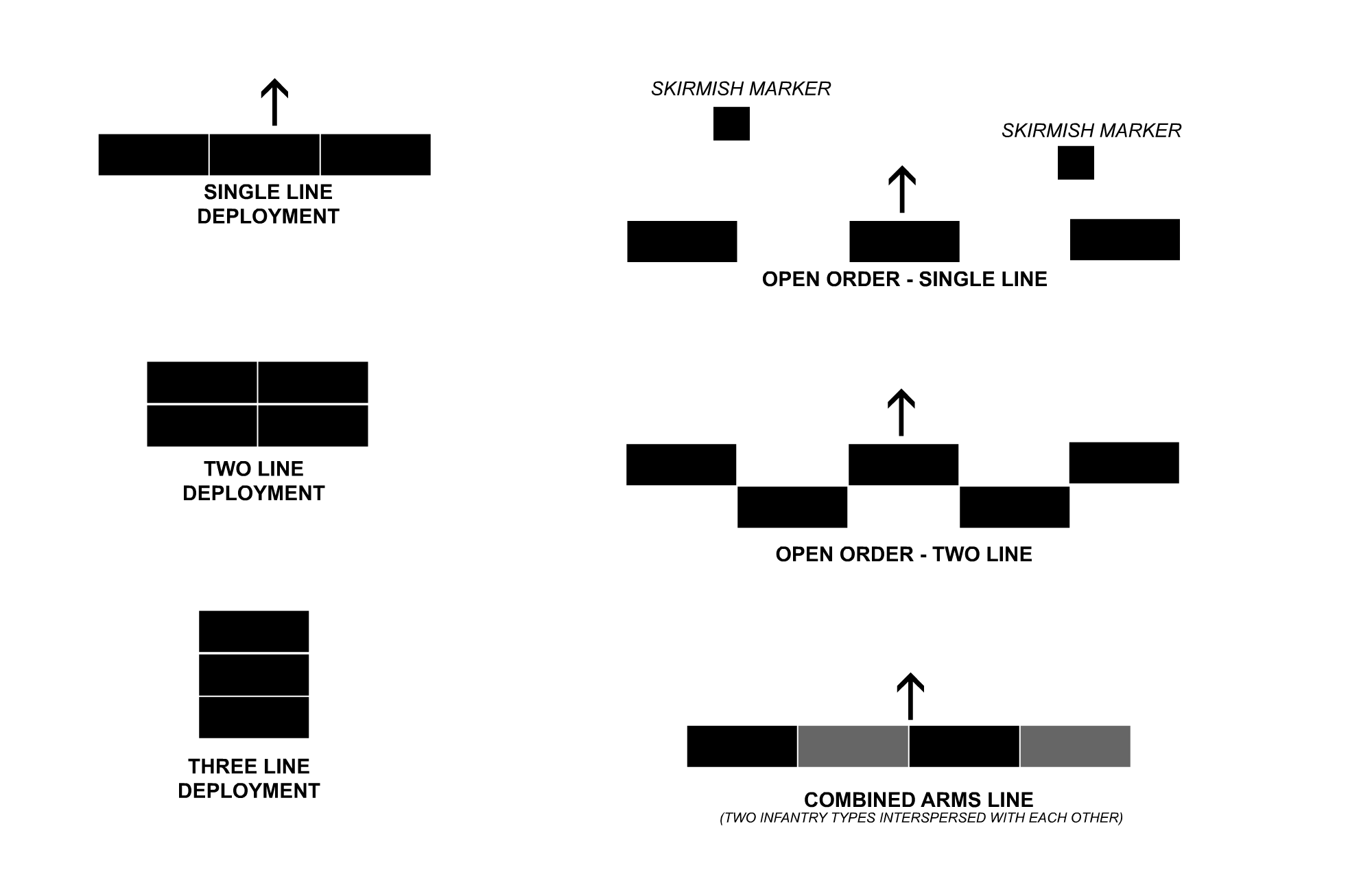 |
|
Figure 1.
Common
formation deployments.
Click on the image for a full size
view. |
|
«
1.4 Deployments. (100 BC Alpha Note: The precise nature of ancient formations and how best to translate them to a standard wargaming deployment is still being worked on. In many cases we will be using modern deployment terminology when dealing with standard or "timeless" formation questions.)
Each group of bases
representing a formation's deployment area are placed into specific
Formations. The words "line" and "column" are only used to distinguish
between shallow and deep unit dispositions, which in ancient times was more a matter of how many ranks deep a commander felt his formation needed to be (which could be a lot).
Deployment Types - Clicking on the thumbnail at left
will show the main types of grand-tactical deployments available for game play
and how they relate to the direction of movement (note movement arrows for
reference). The essential formation level deployments are Single Line, Two Line, Three Line and Four lines, referring to how many bases deep each one is. Unless otherwise stated, formations are considered to be
standard order (three-feet of frontage per soldier) and have the combat bases touching.
Open Order - Also shown in Figure 1 is open
order, which spreads the troops over a wider area (open order would have been six-feet of frontage per soldier). A formation using open order
must space its combat bases at
one-base intervals (e.g. - double normal frontage). While in open order, a
formation may deploy one skirmish marker per combat base. If involved in an
assault against enemy infantry or cavalry which is in close order (all bases
touching), the open order unit automatically counts as disadvantaged, see the
assault section special rules for more information.
Doubled - This is a formation created when troops double the number of files within the same frontage by marching troops from the rear into the existing file intervals, effectively doubling the number of troops present. Doubling was how the Macendonian Greek phalanx was typically formed, which packed each man into a mere 18" frontage. Basically each base contains two standard bases worth of troops pack into one. Doubled formations gain assault advantages against enemies to their front, but are less flexible or Rigid, which negatively affects their movement, endurance and maneuverability. Show doubled formations by removing the base in rear contact with the front base, and placing a thick "Doubled" spacer (base) beneath the combat base receiving the extra troops. Doubled formations are always considered to be Rigid.
Skirmish Markers - In the formation diagram is an
example of two skirmish markers deployed to the front of the single line. These
markers are used to indicate skirmish troops which have been thrown forward by
their parent units. See the Maneuver section for more about allowed distance
between skirmish markers and their parent formations. Not all units are able to
deploy skirmishers, and players should consult the troop lists for more
information on each nation's particular skirmishing abilities or lack
thereof.
Changing Formation - Units may change
between formation deployment types. For example, a formation organized as a single line
may change to a double line, or a unit in a doubled phalanx may change to a
standard deployment. For now (until we can learn more about the process), changing formation takes an entire movement turn while the unit sets in position. The deployment or
recall of skirmish markers is not considered a formation change. See the Maneuver
Systems and Movement Modifiers sections below for more information about the
limits and movement costs of formation changing.
Higher Formations - The formations discussed so far
will usually be grouped into larger sets of units for game play. These could be called armies, wings, columns or forces. Each such force must have a leader in charge. Forces can in
turn be grouped into larger blocks, which will typically be armies overseen by an overall
commander.
«
1.5 The Battlefield
For game play,
the rules consider a few basic types of terrain including normal (open ground),
woods, towns, streams or rivers, roads and marshland, some of which may or may
not affect movement and combat. There are many different ways to show
battlefield terrain including plateau-shaped hill segments, scale trees and
buildings. We do recommend laying out footprints made from gaming mat
material or other gaming terrain to outline the extent of built-up and wooded
areas to make game play clearer. Republic is grand-tactical, so a building
actually represents a town block. Troops inside these areas are not in a single
building, but actually in a general built-up area which may include anything
from fence-lines, plots of land and outbuildings to more substantial town areas, cemeteries and
other town centers. Consult the Terrain Table below for the game-specific
characteristics of various terrain types, which includes most common features
that are not obviously impassable like lakes or the ocean. Section 3.4 Movement
Modifiers describes the specific game board effects that terrain has on
movement.
«
1.6 Starting a Game
Set-up
Guide - See the separate Set-up Guide for extra details that help with
setting up and arranging the scale battlefield and general gaming area. The
guide also gives optional steps that add historical variety to a battle.
Otherwise, the main rules presume that players know how to setup a miniature
wargaming battlefield for game play.
Place troops - Players may simultaneously place their
troops on the board, or they may draw a map and record starting positions
before placing troops accordingly. The second method provides for more
surprises and a hint of fog-of-war, especially in cases where opposing units
start the game in close proximity. Another option is to take an overhead
iPad/tablet photo and then use the Photo Edit function's pen markers to draw
formation locations directly on the photo (or other tablet).
Turn Sequence - Each game turn sequence is
split into two player turns during which each side alternately acts as
the attacker. In order to establish the initial player turn cycle, each side
rolls one die (unless one side is the obvious attacker, as agreed upon
unanimously by both sides). The high roller may decide which player becomes the
first attacker, and the game begins with the first player turn. Players then
alternate turns as attackers throughout the rest of the game, with each pair of
player turns representing one game turn. Each game turn sequence
represents approximately 40 minutes of combat time.
«
1.7 Turn Sequence
Command Phase
- At the start of every player turn each defending player may
immediately send one written or text message to each friendly player. Next, the
attacking side will attempt to reform all units under their respective commands
which have morale hits. The attacking players may move leaders up to 3" during
the rally step in order to place them near units under their command in need of
reforming support. The last step in the Command phase is to replace lost (hors de
combat) leaders with a new leader figure per section 2.5.
ONE PLAYER TURN:
- Command
- Defenders exchange messages
- Attacker attempts to reform units (Leaders
may move 2")
- Attacker replaces hors de combat
leaders
- Attacker Maneuver (attacker function
only)
- Attacker moves units
- Missile & Skirmish Fire
- Both sides conduct simultaneous skirmish
function (block & attack)
- Both sides conduct simultaneous missile
fire
- Both sides check for leader casualties
(dux debilitatus)
- Demoralized panic test (if any demoralized
units suffered P4 hits)
- Assault
- Resolve all assaults
- Both sides check for leader casualties
(dux debilitatus)
- Attacker applies charge disorder
- Panic
- Conduct divisional panic tests (internal
panic).
- Conduct inter-divisional panic tests
(adjoining panic).
|
|
Maneuver Phase - Attacking units may move according
to their respective movement limits.
Missile/Skirmish Fire Phase
- Both sides start by conducting simultaneous skirmish actions per section 4.1.
After all skirmish fire is conducted, resolve all missile fire and assign
resulting hits as required. All skirmish fire and missile fire is considered
simultaneous. Finish the phase by checking for leader casualties (hors de
combat) and panic tests per section 4.7, as needed.
Assault Phase -
Resolve all assaults per section 5.0 until all formations are beyond all-out
assault contact range to the front of the attacking units. Check for leader
hors de combat and apply charge disorder if necessary.
Panic Phase -
Check first for division panic per section 6, then check for interdivisional
panic. Conduct all involuntary moves before ending the player turn. Proceed to
next player turn.
«
2 COMMAND
« 2.1 Chain of
Command
100 BC uses a simple command
system. Every army has an army commander, and the various blocks of troops or Forces will each have a Leader in charge of them. Every formation must either be part of a force, or be under direct control of the army commander (basically, part of a force for whom the army commander is their direct leder). In many cases, the army commander will be a human player, who is then controlling the various subordinate leaders and their respective forces and formations. Even in the rare case of units without any official
leader (a mob or equivalent) a leader who fulfills the role of a commander and
who is considered such for game play purposes should be assigned (or the unit
re-assigned to an existing force who has a leader).
How this all plays out using human players is up to the
participating gamers. The most common scheme is to have one human player in
charge of each army, and the various humans on that side (if any) each controlling one or more of the various forces (and their leaders) on that side. Human commanders communicate with
each other using written messages (or talk in person if their board-level
leader figures are in base-to-base contact). Players may, or may not agree that
one person on their side is the commander-in-chief who issues written or verbal
orders to his fellow players. In some cases, a single human player may be
controlling several forces and there may even be numerous nationalities and army leaders present on each side. In those cases, the human players will be
moving all of the forces under their control, and they simply make
sure that the various leader figures are correctly
positioned on the battlefield for best maneuver, assault and reforming results.
Human Players and Written
Messages
Human players on the same side, whose on-the-board command figures are not in
base-to-base contact with each other are not allowed to discuss the battle or
exchange verbal orders/messages with each other during the game. This includes
not using obvious body language such as pointing at units they want the other
person to move, etc.. Instead, each player may send without delay, one
hand-written or texted message to each other player on their side, once per
game turn at the start of the opposing player's player turn. If a
single player is in charge of several forces, he is obviously not required to send
messages to himself, the written message system is meant purely as a control
over verbal contact between several human players on the same side.
«
2.2 Leaders
Leader figures can
benefit units under their command by using a numbered rating to boost
unit assault performance and by helping with rallying. Each leader also falls
in to one of three classes that affect how quickly they might react on
the battlefield. Each leader's resulting value will be an alpha-numeric with
the class first and the rating second. For example, Robert E. Lee would be an
E4 (Energetic-Four) whereas General Banks would be a C0 (Cautious-Zero).
Leader ratings - Ratings are numbered from
a minimum of minus one (-1) to a maximum of four (4). For use in rallying, the
ratings become steadily less effective at longer distances, as measured in 4"
increments. See the Rally Modifiers section for more information. Below is an
outline of leader ratings and their game related effects:
"-1" leaders - A "Minus One" leader is
either widely despised or dangerously inexperienced, and is probably viewed by
the troops as someone who is going to get them killed. His presence hurts more
than it helps, and he is probably in his position because he is either
politically connected or rich. Minus-one rated leaders only inflict their leader modifier
on units under their direct command.
"0" leaders - A "Zero" leader
is an average officer. He serves as a conduit for the transmission of orders so
that his formations can function, and his personal
commitment and/or rapport with his troops is at a level that is expected for
the circumstances - middle of the bell curve.
"1" leaders - A "One"
leader is a cut above the rest and probably belonged to the top half of his
class (if he attended one). Class one leaders only give their leader bonuses to
units under their command.
"2" leaders - A "Two" leader displays
excellent abilities and is probably being groomed for higher positions. Class
two leaders only give all of their leader bonuses to units under their command,
they may also apply their rally bonus to units in adjoining formations of the
same corps.
"3" leaders - A "Three" leader is at the very top of the
command chain due to some combination of intelligence and personality. He
represents the cream of the crop of the available leadership, with an effective
combination of ability, management technique and bravery. Class three
commanders can give their rally bonus to all units of the same side, regardless
of chain of command.
"4" leaders - A "Four" leader is a famous and
extremely popular commander. They are rare and should only be assigned to very
special cases (Alexander, Caesar, Hannibal, etc).
Leader classes - Are described as Energetic
(E), Proficient (P) and Cautious (C). The leader's class affects how readily he
is able to change formation movement and maneuvering during battle. See the
Leader Ratings page for a list of generally known leaders of the period and
what their classes and ratings are. Leader class can affect assaults and
maneuvering die roll results.
«2.3 Formations and Rallying
Formation
Status - During the game, units can suffer Formation Hits which
degrade their effectiveness and increase the chances that they will attempt to
spontaneously withdraw. The ideal unit condition is Formed, which
represents a unit fully under the control of its officers and able to perform
as ordered. Formed units have no formation hits. If one formation hit is suffered,
the unit becomes Unformed. If the unit has not reformed when another
formation hit is inflicted, it will become Disordered. If another formation hit
is suffered, the unit becomes Broken, etc.. Units can recover from formation
hits by reforming, but they may also suffer more than one formation hit at once.
Shown below are the possible formation conditions (condition and status being used interchangeably for this) and their associated
restrictions.
Formed - Unit behaves
normally.
Unformed - Unit may not change formation.
Disordered - Unit may not change formation or deploy skirmishers. Formation (any type) will not assault enemy units.
Broken - Unit may not change formation, about-face
or deploy skirmishers. Formation will not advance toward or assault any enemy units. Missile capable units are silenced.
Scattered - Same as Broken, plus formation will suffer one panic hit for each
additional formation hit inflicted upon it by skirmishers and/or
missile fire. Javelin equipped formations may not use their assault bonus. Scattered units which have assault moved during their turn will remain
scattered, the "extra" assault disorder formation hit does not apply or convert
to another type.
Troop Grades - Every unit on the board will have a
Troop Grade which reflects its level of training and experience. The
Units and Formations page linked on the Republic home page includes common troop grade values for the best known
formations along with notes about their use for game play. Shown below is a
list of available troop grades:
Elite - These troops have the best
combination of training and experience. Unlike many others, they know
close-order drill with precision and are highly experienced with their weapons.
Veteran - These
troops have a lot of warfighting experience and know how to get the job done.
Seasoned -
These are men who have seen some action and received enough on-the-job training to hold their ground. Average, steady troops - at least for now.
Novice -
These are men who have seen little or no action. They have probably received some training but under stress might
still freak-out.
Untrained - These are men who have been pulled in to fill the ranks,
but have received almost no training except possibly some minor weapon drill. Not much to be expected from them.
Reforming - During the reform step of every command
phase, the attacking players must attempt to rally all of their units that have
one or more morale hits. To make a rally attempt, follow the sequence listed
below for each rallying unit:
- Take note of the Reform table number that matches the
current status (condition) of your unit. To do this, cross reference the troop grade and
formation status, this is your old reform number.
- Roll 1D6 and modify the result using the die roll
modifiers listed in the Reform Table on the combat chart. Apply the modified
result – positive or negative – to the previously noted old reform
number. The resulting value is your New Reform Number.
- Match the new reform number with the value on the
corresponding reform table line to which it is equal-to or greater-than.
- The formation rating listed at the top of the matching
column from step 3 is the unit's new formation condition. Note that it is possible
for a unit's formation to improve, get worse or remain the same.
Example 1: A Disordered Novice unit which
has suffered 50% casualties rolls 1D6 with a result of a 3. The 50% casualty
level modifies the result downward by two points (-2), reducing it to a 1. That
value is applied to the unit's starting value of 4 (the starting value for a
novice, disordered unit will always be a 4 as listed on the table). This raises the unit's value to a 5, resulting in no change to the formation's formation - it needed to be a modified 6 in order for its condition to improve to Unformed. If the die roll had been a 6, the
modified value would have been a 7, which would have been enough to improve the formation's condition to Formed (i.e., No formation hits).
If the die roll had been a 1, the modified effect would have been a -1, which
would have reduced the formation condition to a 3, causing the unit to become
Broken.
Reform Die Roll Modifiers
- Ea. leader rating point - If the formation's
leader is still alive (not debilitatus - dead or otherwise out of commision), add his number rating as
points to the rally die roll, regardless of the leader's distance. If the
divisional leader has become dux debilitatus (presumed dead) and not yet been
replaced, subtract his number rating as points from the rally die roll. Zero
rated leaders obviously result in no modifier either way. If an army
leader within the unit's chain-of-command is within 4" of the unit, his rating
may also be added. These ratings are cumulative and can add a considerable
rally bonus of all their values combined.
- Each 4" to divisional leader - Subtract one point
from the rally roll for each 4" beyond 4" distant that the unit's divisional
leader base is located, to a maximum of minus six points
(-5). This includes the bases of dux debilitatus leader bases which have been moved to the rear pending replacement. Calculation of the 4" increments is rounded
up, so for example if the divisional commander is 9" away from the reforming
brigade, that is a -1 distance modifier.
- Percentage of unit lost - Subtract from the rally
die roll the percentage amount that corresponds to the unit's current losses
from base hits.
Replacing Fallen leaders - When a leader is rendered dux debilitatus (out of action), the figure is moved to the rear of its
respective command and flagged with a dux debilitatusmarker. That leader
base will remain out of action and unable to contribute to unit assault or
morale results until the Replace Leaders step during the controlling player's
next command phase as attacker, at which time base status is resolved as
follows:
Force leader - The original figure is retained and
resumes its original command at a one point reduction in rating from before, to
a minimum value of zero (zero level divisional leaders do not become a negative
value). Negative value leader replacements are a zero (which gives the troops
something to hope for).
Army leader - The figure is removed from game
play. Its position is taken over by the highest rated leader available who is
ranked next in chain of command. The rest of the chain of command below that
level may also need adjusting, to the point that a fresh force command
figure may need to be supplied from off-board to fill the gap.
«
3 MANEUVER
There are two
aspects to this phase: Movement and Maneuver. Movement is done by individual
brigades as they march together toward a certain goal. Maneuver is the process
by which the divisions (that are made up of brigades) achieve their orders.
Orders in this sense being what the controlling player wants the division to
do.
| |
PLACE HOLDER FOR WHEELING FIGURE |
| |
Figure 3.
Oblique
movement and wheeling. Note that the wheel is measured along the outside of the
wheel movement.
Alpha Note: Pre-Roman forces were not likely able to wheel outside the context of individual bases. A "wheel" as we know it in modern terms would have been conducted by 256 man subunits in a grid pattern, with the final result being a new line/phalanx facing 90 degrees to right or left. But an entire phalanx (much less a larger force) would not likely be able to wheel en-masse. Roman formations were better able to do this, presuming adequately trained. Still working on this and how it applies to the rules. |
«
3.1 Movement
Each of the major
troop types used for game play have movement allowances which represent
the total normal distances they are allowed to move during any one player turn.
These allowances are shown in the Movement Box on the Combat Chart. Units may also
use an assault (charge) movement bonus, any portion of which may be used during
the course of a turn's maneuver phase. This extra movement allowance permits a unit to cover a greater distance during
its turn, but use of any of the extra assault movement will also cause
the unit to suffer one formation hit (1F) at the end of the turn. It may be used for any purpose to press a unit forward, and may be used even if the unit will not be conducting an assault that turn. Players
conducting assaults are advised to mark unit starting positions to more easily
track remaining movement for breakthroughs and carrying positions (blank bases
work best). Leader bases move at the speed of charging horse (size depending on period).
A unit's movement allowance is based on forward movement as
measured from the front edge of its bases. Reversing the facing direction of a
unit counts as a formation change. All movement
penalties are cumulative.
«
3.2 Maneuvering
Players may
advance, hold or otherwise maneuver their forces at will, so long as
those movements align with the previous turn's moves. This is called an
Inertial Action system of maneuver, meaning that a force may freely
repeat the movement action that it executed on the previous turn. If a
commander wishes to make a major change to a force's mode of movement or
maneuver (Stopping an advance, etc.) a die roll test will be needed to see if
that order change succeeded. The force commander's Leader Class
(Energetic, Proficient or Cautious) controls the basic odds of passing this Maneuver Test should it be necessary. The basic movement/maneuver orders
available for game play are:
Advance: A force is Advancing if
any of its member formations move more than half of their available move (before
application of movement penalties) in the direction most of its units are
facing. An advancing force may freely change the direction of its advance
(maneuver) less than 45 degrees. Attempts to immediately (within the turn)
change to hold, pull back or maneuver more than 45 degrees (see below) will
require a die roll. A force that already advanced last turn requires no
extra die rolls to continue its advance on the current or following turns.
Hold: A force is on Hold if its
units are either completely halted or are moving 4" or less (before application
of movement penalties) during their turn. It may freely Pull back, but must
pass a maneuver test in order to conduct any type of Advance action. A force
changing from Hold to Advance may combine "Advance" with "Maneuver" if the
change in direction is done immediately - the holding force (or some if its formations) must change
facing direction instantly upon moving out. If the force advances some
distance before attempting the Maneuver change of direction, then a second die
roll test would be required as noted above in the Advance section.
Forces on Hold may change their facing direction for free, so long as the
greatest distance moved forward by any of their member units does not exceed
4". Artillery bases assigned to a division operating on Hold may use full
movement in order to reposition themselves within the force's deployment
area.
Pull back: A force that is pulling
back is moving backwards (not facing its direction of movement). Forces
pulling back may not use the assault move bonus or conduct Maneuver changes of
direction, and must roll for a change to Advance.
Maneuver: Any force with one or
more units changing their overall direction of advance by 45 degrees or more is
conducting a Maneuver, which requires a maneuver die roll. Passing the one die
roll allows for two major changes of direction during the course of that
movement phase, by any number of units within the group.
These basic orders may be marked on a map or tracking sheet,
publicly declared and remembered by players, marked on playing chits kept next
to the corresponding divisional commanders, or any other method that works for
tracking.
Engagement Range – Once any units of a
force move to within eight inches (8") of enemy units (or otherwise find
themselves within that range) all units in the group may move as needed in
order to fight or otherwise engage the enemy formations. This is the Engagement Range, which temporarily suspends the requirements of the
force's current orders. Even if it means a temporary hold to
forward movement, or execution of local advances to counterattack threatening
enemies, such movements are considered part of the local action within the
engagement range. If the force manages to clear the enemy troops out of
its way, it will resume its original order status without having to roll for
new orders. Commanders may roll to change a force's underlying orders even
while the group is operating at-will within the engagement range, so that
once its front is clear of enemy troops (i.e., all beyond the engagement range)
it can be operating under the new orders.
Conducting Movement & Maneuver -
Presuming the force's units are repeating the previous turn's actions, the
player simply moves or holds his units accordingly. Forces only need to roll
for a maneuver test if they want to make a change in action that appears on the Change (From > To) column in the maneuver table.
This decision happens during the maneuver/movement phase, starting with the
force of the active player's choosing. Any order change combination not
listed on the change table requires no die roll test, allowing the player to
freely move or hold his units per the current/new active orders. To conduct the
maneuver test, use the force commander's leader-class code of Energetic,
Proficient or Cautious to find the corresponding Change value. The player must
roll a modified number that is equal to or greater than the value shown. On the
right side of the table is a list of die roll modifiers to be applied to the
maneuver roll:
Maneuver Die Roll Modifiers
- Pre-Arranged Signal = Add a plus two
(+2) if the formation is acting on a pre-arranged signal (horns, fires, flags, drums, etc.).
- Multiple forces acting together = Add a
plus one (+1) to the die roll if one or more other friendly forces within 6"
(as measured between nearest points between closest units) are conducting the
same To movement. The forces do not need to be
running the same maneuver state, they only need to all be changing to the same
one. Example: An army has two adjoining forces holding and one nearby force
pulling back. If all three are within 6" and all changing to an Advance, each
rolls with the modifier bonus.
- Energetic army commander = Add a plus one
(+1) if the army commander is energetic.
- Army commander beyond 12" = Subtract one
(-1) if the force's army commander is more than 12" away
from the leader's base. This automatically includes the bases of
leader casualties (dux debilitatus) which have been moved to the rear pending
replacement.
- Leader just replaced = Subtract one (-1) if
the force's leader was replaced at the beginning of the turn.
- In rough terrain = Subtract one (-1) if
half or more of the force's units are in rough terrain.
- Worn force = Subtract one (-1) if the
force is worn, defined as every primary unit having
any base (B) or formation (M) hits as of the start of the maneuver phase. Primary
units are (for example) all of the infantry units in an infantry force, etc.
«
3.3 Forced Movement
Units required
to move according to a combat action or result will do so regardless of their
current turn status or movement allowance. These mandatory (forced) moves may
occur during the following conditions:
Movement Phase: Skirmish marker
evasion due to displacement by advancing enemy combat bases.
Missile Phase: Due to formation hits on scattered units
auto-converting to panic hits.
Assault Phase: Movement
required by assault results (panic hits) or force panic.
Forced retrograde movements such as rout, retreat and
withdraw are not subject to terrain penalties or formation restrictions and
will always be conducted out to the maximum distance required for that
mandatory order. If the mandatory move cannot be executed without direct
stacking of formations (two units sharing the same space) then the unit
conducting the mandatory move must execute the next move option down the list
(e.g. - A withdrawing unit stacked on another unit becomes a fall back in order
to clear to the rear of that other unit).
Disengage = Move 4" away from enemy,
facing enemy.
Withdraw = Move 6" away from enemy, facing
enemy.
Fall Back = Move 8" away from enemy, facing away from enemy.
Retreat = Move 10" away from enemy, facing away from
enemy.
Rout = Move 12" away from enemy, facing away
from enemy.
Mandatory advances - usually the
result of Assaults - may be conducted only to the limit of the moving unit's
available movement remaining from that player turn's Maneuver Phase. Forced
advances are in turn subject to cancellation by subsequent assault rounds that turn which
may change the assaulting unit's actions.
«
3.4 Movement Modifiers
- Rough Movement = A unit with any of its
bases within rough terrain will move at a reduced speed, as a percentage of its available movement. For example, a foot (infantry) unit moving in rough can move 75% of its available 8" speed, which would be 6". A light chariot would move 25% of its available 14" of movement or 3.5".
- Exhaustion Hits = Units with Exhaustion hits (fatigues, worn, exhausted) will move at a reduced speed, as a percentage of its available movement. This modifier is cumulative with the rough movement modifier.
«3.5 Special rules
Passage of Lines - Veteran and elite units may pass through other veteran or elite formations without penalty once during
each move turn (neither unit may be in a Rigid deployment). If a second unit is passed through, the moving
formation may not use its assault move bonus that turn.
Skirmishers - Light infantry units may deploy their maximum allowance of skirmish markers at any time
during their movement phase. Skirmish markers must remain within 4" of their
parent unit. They may not be placed in a position which puts enemy bases
between them and their parent unit. In order to count as being in skirmish
order, friendly skirmish markers must remain at least 1" away from each other
(as measured between bases). Skirmish markers must always surrender their positions (i.e.
- give ground) to enemy combat bases.:
Cavalry Reaction - Cavalry units may react to
enemy units which advance to within 6" of their front (not flank or rear
as defined by the Flank and Rear Examples in Assault modifiers) during an
opposing player's Maneuver Phase. Reacting cavalry may dismount (if able) or
begin moving as soon as enemy units approach to within line of sight or 6",
whichever is less. Both sides then pro-rate their movement until the reacting
cavalry and enemy formations have either completed their movement, contacted or
approached within general or all-out assault range. Reacting cavalry may not
change formation, but it may conduct retrograde movement (away from the enemy).
Attacking players may not pre-measure distance from their units to enemy
cavalry units in order to avoid cavalry reaction, the check for reaction may
only occur when the defending cavalry owner declares the reaction distance
check.
| Terrain
Effects |
| |
Movement |
Cover
Rating |
Spotting
Depth¹ |
| Penalty |
Assault Move |
Impassable to: |
| Terrain Features
(penalty when within) |
| Light buildings (light stone, medium wood) |
- |
Foot only |
- |
1 |
2" |
| Medium buildings (medium stone, heavy
wood) |
Rough |
Foot only |
- |
2 |
2" |
| Heavy buildings (heavy stone & masonry) |
Rough |
Foot only |
- |
3 |
2" |
| Light forest, Orchard, Grove |
- |
Foot only |
- |
- |
1" |
| Medium forest |
Rough |
N/A² |
- |
1 |
1" |
| Heavy forest |
Double Rough |
N/A |
- |
2 |
1" |
| Marshland |
Double Rough |
N/A |
Artillery |
- |
- |
| Vineyard |
Rough |
N/A |
Artillery |
1 |
2" |
| Steep, rocky ground |
Rough |
N/A |
- |
2 |
2" |
| Ford |
Double Rough |
N/A |
- |
- |
- |
| |
| Obstacles (penalty to
cross) |
| River bank, Cliff |
Impassable |
N/A |
Artillery, Horse |
- |
- |
| Stream bank, Ravine |
-3" |
N/A |
Artillery |
- |
- |
| Stone wall |
- |
Foot only |
Artillery, Horse |
2 |
- |
| Entrenchment, Embankment |
- |
Foot only |
Artillery |
3 |
- |
| Treeline |
-1" |
Foot only |
- |
1 |
- |
| Hedge |
-1" |
N/A |
Artillery, Horse |
1 |
- |
¹ Spotting Depth is how far into that
cover a unit can be spotted and attacked with skirmish or artillery
fire.
² N/A means assault move bonus not allowed in or across terrain
feature. |
«
3.6 Terrain Effects
Battlefield
terrain will frequently affect a unit's ability to move freely around the field
of battle. The Terrain Effects section at right shows a list of common terrain
features and their effects on movement. Units may conform their front line to
local terrain such as hillside, edges of woods, blocks of buildings, streams,
etc. By contrast, units in the open must maintain their linear deployments
within the limits of the Formations section. When paying movement penalties for
moving through rough terrain, a unit continues to pay that penalty so long as
any portion of it remains within the terrain in question.
«
4 MISSILE FIRE &
SKIRMISHING
«
4.1 Skirmishers
Skirmish markers
represent dispersed slingers, arhers and javelinmen who screen against enemy
skirmishers and try to spread disorder in enemy combat formations. Skirmish
markers within woods or buildings may project their 4" engagement range through
the terrain if they are not blocked by friendly combat bases or terrain effect
restrictions.
Combat - Skirmishers for the attacking player
attempt to shoot at and score morale (M) hits on enemy brigades. Skirmishers for the
defending player attempt to block the attacking skirmishers from firing at
defending units. This results in skirmish markers alternating between being the
attacker and being the defender as the turns change. Use the Skirmishing table
on the combat chart to resolve skirmish combat.
Defend (Block) - A defending skirmish marker
may attempt to block the closest enemy skirmish marker that is within 4" of it.
A blocked skirmish marker may not attack enemy combat bases that turn. To
attempt a defensive block, declare the defending marker and which attacking
marker it will try to block. Roll 2D6 (two six-sided dice) and consult the Block column in the
Skirmishing table. If the die roll number is equal to or greater than the
number shown for the corresponding troop grade, the attacking marker is
blocked. Defending players must declare all blocking attempts before rolling
the dice. Multiple defending skirmish markers may attempt to block any one
attacking skirmisher.
Defensive Fire - Defending skirmish markers that are opposed (within 4") by enemy combat bases during the enemy player turn, may fire on those bases per the Attack outline above, if there are no enemy skirmish markers within the standard 4" engagement range for blocking actions. This is the one time that defending skirmish markers may conduct more than a blocking action.
Attack - Attacking skirmish markers not
blocked by defending enemy skirmishers may fire on enemy combat bases within
4". The attacking skirmish markers must have line-of-sight to their target and
may attack once per turn by rolling a 2D6 and referring to the
Skirmishing section of the combat chart for range limits and results.
Each successful attack will score one formation (F) hit on the targeted defending unit. If
the attacking skirmish marker is untrained or green and rolls a low number that
matches the Flee column results, the marker is picked up (it flees back
to the parent formation).
Skirmish bases cannot score F hits on other
skirmish markers but may, if unblocked and in range, fire at the parent unit(s)
from which the enemy skirmishers originate. All skirmish fire results take
effect at the end of the artillery phase (e.g. - skirmish and artillery fire
are considered simultaneous). Attacking skirmish fire effects are the same
against both close and open order targets.
«
4.2 Missile Fire
During each
Missile Fire step, archers, slingers and other bases capable of throwing projectiles (hereon called archers for simplicity) for both sides may either fire on
enemy units or announce that they are saving their fire which may give a firing
bonus on later turns. A firing unit has an effective arc-of-fire totalling
60 degrees measured from the outer front edges of its base (a free firing arc
is available on the 100 BChome page). In order to conduct missile fire,
repeat the following sequence for each firing formation:
Step 1: Cross index the range column on the
fire chart that matches the target range, with the unit type. The result showing in the cell is your basic
effect.
Step 2: Apply the Range Column modifiers by moving the basic
effect one cell to the right or to the left per modifier point.
Step
3: Roll 1D6 and add or subtract the applicable die roll modifiers.
Step 4: If the modified die roll is a 6 or greater, move the basic
effect another one cell to the left. If the modified roll is a 1, move the basic
effect one cell to the right. Note that in many cases you will already
know if there are no column modifiers and you will go straight to the die roll.
If the die result is a very "middle" number like 3 or 4, you can quickly deduce
that the final effect is your original cross indexed value.
An archer unit may only fire once each player turn
(twice each game turn), although fire is not mandatory. Archers and ballistae may over friendly units, if the enemy target has at least one range gap to the front of the blocking friendly formation. Slingers must have a direct line of sight to the target formation. All standard missile fire conducted during this Phase
is considered simultaneous, and damage to targets is applied at the end of
the phase. The exception is moving units, which can still
fire but lose simultaneous fire privilege against stationary enemy missile troops.
Joint Fire - Multiple archer bases able to
fire at the same target at the same range, may group their fire to gain a
mass fire effect, which increases the odds of scoring base hits
against targets. Joint fire uses the same sequence as normal
single-base fire, with the added benefit of a "mass fire" modifier
reserved only for joint fire use (see Missile Modifiers below). The
major difference is that the final modified result against the target is all
the damage the unit will receive from the entire mass battery. Unlike regular
single base fire, the result shown is not from each base
firing.
Artillery bases may downgrade their range or fire weight factors
to participate in joint battery fire with other batteries. For example, if one
base is within 8" of a target and three other bases are within 10" of the same
target, the closer base may participate in the joint battery fire, effectively
downgrading its firing range to gain the benefits of the joint battery fire. A
base at longer range than the other three bases may not join (unless the other
three bases want to downgrade their ranges to the longer range). Another
example would be a heavy battery giving up its "H" weight in order to
participate in joint battery fire with a group of medium artillery
batteries.
«4.3 Artillery Range Column Modifiers:
The artillery range column modifiers move your base fire effect to the
left (more effective) or right (less effective). Range column modifiers are all
cumulative.
- Deep/Rigid Target - Move one range column to the left
if the target is two or more
combat bases deep. The target bases do not need to belong to the same unit, but must all be in
open terrain and within natural (unmodified) effective missile range. The deep target modifier is not applicable to targets in
woods or buildings.
- Joint Fire (per base) - Move one range
column to the left for each aditional participating base (beyond the first base) in a firing group
of bases (usually an archer or slinger formation of some type).
- At moving cavalry/chariots - Move one range column to the
right if over half of the missile target is made up of moving cavalry or chariot bases.
To qualify as moving, the targeted formation must have moved more than
half during their last move opportunity. If on their last move opportunity
(including both regular move or breakthrough/overrun options) they did not move
more than half of their available movement, they are considered stationary for
purposes of missile fire targeting.
- At Cover - If half or more of a
target unit is in medium or heavy cover, move two range columns to the
right (see defense classes under Assault).
- Each F and E hit - Archer units
which begin the fire step with Formation and/or Exhaustion hits will move one range
column to the right for each hit (of either type, applied cumulatively).
- Easy Target - Move one range column to the left if the target is an Easy missile fire target (usually unarmored/unshielded troops).
- Tough Target - Move one range column to the right if the target is a Tough missile fire target (usually very heavily armored troops, or troops drilled/equipped to defend against archery).
- Move - Move two range columns to the right if the firing unit moved this turn.
- Passing Fire - Subtract two points (-2) from the
die roll if the artillery is conducting passing fire during the enemy movement
phase.
«
4.5 Targets
Main Targets -
Each artillery battery must fire at the unit which is; 1) the closest
infantry/cavalry or artillery threat, i.e. - the closest combat base(s)
occupying the closest artillery range bracket to the battery (infantry and
cavalry targets take priority over artillery targets) and; 2) closest to the
battery's Center of Fire. Different artillery bases may only converge their
fire onto one unit if these rules are not violated as a result or if a massed
battery is firing (measure from the centerline of each four-base mass battery
group to establish main target).
Secondary Targets - Secondary targets are units which
suffer collateral damage due to their close proximity to main targets. There
are two types of secondary targets: tandem and adjacent. Tandem secondary
targets may suffer damage both in place of, and in addition to the main
target. Adjacent secondary targets only suffer damage in place of the main
target. If both types of secondary targets are near a main target, an adjacent
target will only suffer hits if both main and tandem targets are
eliminated.
Tandem Target: A tandem secondary
target is any unit which is within the attacking battery's firing zone
and within 3" of the main target's front. Tandem secondary targets must also be
in open terrain. Secondary tandem targets always suffer half the number of
morale hits as the main target in addition to the main target's morale
hits. They also share approximately one-third of the total base hits
rolled on the artillery fire chart, always rounding down. If all bases in the
main target are killed, the unit in the tandem target position closest to
attacking battery center-line will suffer the balance of the required base hits
(if any).
Adjacent Target: An adjacent
secondary target is any unit within the firing battery's firing zone
which is next to, and within the same range bracket as, the main target. If all
the bases in the main target unit are destroyed as a result of one die roll and
there are no tandem targets, the adjacent secondary target closest to attacking
battery center-line will suffer the balance of the required base hits and
morale hits not absorbed by the original main target.
Firing zone - A battery's firing zone is a
cone-shaped area beginning at an artillery battery's front through which
battery fire is directed at targets. The firing zone is tapered outward 10°
and may be swung throughout a battery's 60° degree arc-of-fire. It must be
free of friendly combat bases (or any parts thereof) and markers in order for
the battery to be able to fire. The firing zone should not be confused with the
arc-of-fire, which is the stationary zone representing a battery's available
firing arc. The width of a battery's firing zone will match
its current frontage, either packed battery state (exact base width) or normal
frontage (double base width). The default assumption is if the battery has been
placed on the field with enough open space to either side to allow for normal
frontage deployment, that the battery has automatically used that space.
Declaring it in advance is good practice, but not mandatory.
Arc of Fire - A battery's arc of fire is a
cone-shaped area beginning at an artillery battery's front through which the
battery's firing zone may be swung in order to establish whether a potential
target can be fired upon. The arc-of-fire itself is tapered outward 60° and
is locked in a stationary position onto the battery front – it may not be
moved or swung into different positions in order to bring potential targets
into the arc. Half or more of one of a formations bases must lie within a
battery's arc-of-fire in order to quality as a valid target. The outer edges of
the arc-of-fire are marked "60° Maximum Arc" as emphasis of the limits on
the battery's effective field of fire. As with firing zones, a battery's arc of
fire will match its current frontage (packed or normal).
Line of Sight - A battery must have direct
line-of-sight to its target, it may not conduct indirect fire over obstacles,
friendly units or enemy units. Friendly units block light of sight for
artillery. See the terrain effects table for limits on spotting units located
within blocking features such as towns or forests. All of a mass battery's
individual bases must have a clear line of sight to at least one full base
belonging to the targeted formation.
Passing Fire - Artillery may conduct Passing
Fire at any enemy unit about to move out of the firing battery's
arc-of-fire (i.e., applies to artillery fire conducted during the opposing
player's movement phase). This applies to units passing completely through the
arc-of-fire or to units which were already within the firing arc at the start
of movement. Batteries saving fire may use passing fire with their Saved Fire
modifier applied. Those batteries which conduct passing fire may not fire
during that turn's artillery phase, and they do not receive saved fire as a
result of that missed phase.
Skirmisher Targets - Archers may fire on fully
deployed skirmish markers (markers with at least 2" between bases). If fully
deployed skirmishers are between an enemy battery and its target, they do not
mask or protect the target. Artillery may fire on packed skirmish markers. If a
skirmish marker itself is targeted (while "packed") and hits scored, the
M hits are passed directly to the parent formation who will continue to
sustain the skirmish marker screen. Each B hit on a skirmish marker
causes the Type rating for the skirmishers from that unit to go down one level.
For example, a unit with Veteran skirmishers who suffers a B hit
on one of its skirmish markers results in skirmishers for that unit dropping to
Green level.
«
4.6 Missile Fire Results
Target
units can suffer Formation (F) hits and/or Base (B) hits as a result of missile
fire, and may also indirectly suffer Panic (P) hits. Assign hits according to the target rules. Scattered combat units which
receive F hits as a result of missile fire will receive one Panic (P) hit for
each extra hit type suffered beyond demoralization. This includes units already
scattered at the start of the missile phase and units which become
scattered during the phase. Any panic hits inflicted are still active for
purposes of army panic even if B hits completely destroy the unit in
question. As noted above under Skirmish Targets, skirmish markers which
suffer F hits will pass those hits on to their parent unit and B
hits due to missile fire degrade quality of the unit's skirmish type.
Example: A disordered unit which suffers three F and
one B hit will become scattered with one P hit added (due to the "extra" F
hit beyond scattered). If the same unit started the missile phase already
scasttered, it would suffer three P hits - basically all F hits would convert
to P hits at that point.
«4.7 Dux Debilitatus and Panic
Conduct
the following tests – as required – after all skirmish actions and
missile fire has been resolved. Because these tests can end up being
conducted twice during the player turn (once at the end of Missile Fire and one at
the end of Assault, as required), some rules noted below technically apply to
the Assault section.
Dux Debilitatus - Check for leader loss (dux debilitatus); roll 2D6 for each leader who was within 4" of any unit that
suffered base hits during the phase in question. If a die roll is doubles (two
of the same number) reference the Dux Debilitatus table on the combat
chart to see whether the result is a casualty. Failure to roll doubles is no
effect, he lives to fight another 40 minutes.
All die roll modifiers affect the individual doubles
numbers; for example if a player rolls a 5-5 for their leader who was near a
brigade that lost two bases, the 5-5 becomes a 7-7 because of the +2. If a
player does not roll doubles, the modifiers do not come into use because
non-double rolls cannot result in leader casualties.
Dux Debilitatus Die Roll Modifiers:
- Each base hit (B) within 4"- Add one (+1) to the
die roll for each friendly unit within 4" which suffered base
hits. The modifier is cumulative; add one point per base hit within range.
Applicable during both the Missile Fire and Assault phases.
Leaders rendered dux debilitatus are moved 12" from their
current position toward the rear of their respective command and flagged with a Dux Debilitatus marker. The leader (command) base will remain out of
action until the loss is resolved during the controlling player's next Replace Lost Leader step.
Panic Hits - Execute all involuntary movements as a
result of panic hits which occurred due to excess morale hits on scattered
units. As with other panic hits suffered outside of the assault phase, any base
hits suffered in case of a Panic 4 event count as deserters and are immediately
removed. Do not check for army panic at this time. For
pending assaults in which all targeted defending units rout, retreat and
otherwise disengage, the attacking formations may automatically carry the
position.
«
5 ASSAULT
« 5.1 Assault
Procedure
This phase represents the melees, charges
and miscellaneous short range missile hurling which occur in the confusion of close combat. When moving
into assault contact with an enemy formation, the attacking player must decide
whether to conduct a General Assault or an All Out Assault (see
below). In both cases the assaulting formation(s) must be facing toward the enemy
formations and they must declare the target unit(s) that they have the greatest
contact frontage with as the primary defenders. Primary attackers and defenders
count all of their bases toward the assault strength total, and they block
assault activity for units behind them. To be considered within assault range, the front
edge of at least one full base of the attacking unit must be within the assault
zone boundary (i.e., there must be the appearance of solid contact). This
contact frontage within the assault zone is called the
contact face.
Skirmish markers do not interfere with
assault proximity and do not apply their bases to the assault. Both general and all-out assault windows extend into and through all cover
types.
 |
| Assault Contact - Diagram showing the All Out
Assault and General Assault zones, which extend 2" and 4" respectively from the
face and forward flanks of the formation. The outward angle of the zones are
5º per side, which is the same as the artillery firing zone. |
General Assault: Attacking formations approach to
within 2" of the defending enemy formation, but greater than 1" range. They may
initiate the assault from this distance per the steps outlined below.
All Out Assault: Attacking formations approach to
within 1" of the defending enemy formation. They may initiate the
assault from this distance per the steps outlined below, which triggers the
following additional actions: a) Add an extra +1 to the assault modifier for friendly
E or P class leaders within 3" of the attacking unit (for a total bonus of +2), b) The
modified die roll loser of the All Out assault suffers a one line "bump"
outward (away from the zero line) on the assault results table. For example, if
a winning attacker scores on the 8,9 line against the defender, the results
bump up to the 10,11 line. If a losing attacker scores on the -5,6 line, the
results bump down to the -7,8 line.
Each assault is resolved in the Assault section of the
Combat Chart as follows:
Step 1: Establish which assault table to
resolve the action: Attacker Advantage, Pitched Battle or Defender Advantage.
Each table column includes brief outline descriptions of applicable conditions
for using each (see Assault Tables below).
Step 2: Each player adds
all applicable assault modifiers for their formations and applies them to the
result of one six-sided die roll (players roll 2D6 each).
Step 3:
The attacker then subtracts the defender's modified result from his own to
arrive at the die roll difference.
Step 4: Refer to the die
roll difference values shown in the corresponding assault column located in the
combat chart's Assault table. High rolling attacker values (defender loses)
force results that are above the zero line and apply to the defending units.
Low rolling attacker values (attacker losers) force results that are below the
zero line and apply to the attacking units. The results in the middle of the
assault table force either a break-off or re-roll of a second round.
Step 5: Immediately apply the resulting panic and base hits to the
involved units. All initial assault rounds must be resolved before re-rolls and
breakthrough overruns are carried out. Mark breakthrough locations before
moving on to resolve other assaults.
Step 6:Leaders which have been near units that
suffered base hits in the current assault round (see combat chart for actual
distance) must roll for hors de combat.
Step 7: After the first round of
assaults is resolved, conduct all breakthrough movements and other mandatory
moves (if any) required by the assault results. Then repeat steps 1 through 6
for any additional assault rounds which need to be resolved.
 |
Flank and Rear Examples - The
flank zone for unit A is described by a line that runs along the rear of
the front bases, parallel to the unit's front. The rear zone is
bounded by lines running to the rear from the outer rear base corners,
perpendicular to the unit's front. Unit Y is in a flanking position because
part of one of its bases is past the flank line for unit A. Unit Z is striking
in the rear because part of one of its bases is past the rear line for unit A.
Units struck in both the flank and rear will only suffer the worst of the two
effects, not both.
|
Example: EXAMPLE TO BE INSERTED HERE.
Follow-up Assaults - Some assault results may trigger
several rounds of assault rolls. As long as defending enemy units continue to
face the attacking unit within the attacker's all-out assault zone (not the 4"
used to trigger the initial assaults) they will continue to trigger new
assault rounds. This would apply whether or not the assaulting unit(s)
conducted carrying of position, breakthrough, etc. Assault contact is only
broken when the attacker is no longer facing enemies within All Out assault
range.
«5.2 Special Rules
Mixed
Assaults - If some attacking units advance to the All Out Assault
range, while adjoining friendly units participating in the same assault remain
at General Assault range, this is called a Mixed Assault. Mixed assault
attackers cannot use the +2 All Out bonus for E leaders within 3" (They
may still use the standard +1 bonus). If a unit defending against any
assault type is supported by a friendly defending unit that has bases partly or
wholly within the attacker's assault zone, and which are not blocked by other
friendly bases, the defender may apply only those supporting bases (not
the entire unit) toward the overall strength total. See Supporting Units under Assault Results.
Vacated Defense - Attacking units which were in
assault range of enemy bases, but rendered out of assault range due to
missile or skirmish fire related enemy withdrawals or base losses, may expend
the balance of their available normal or assault movement (if any) to advance
or establish assault contact with fresh assault targets. Such moves may not
violate existing force maneuver limits (a holding force's units may not
move more than 4", etc.). Players intending to resume movement for qualifying
units must declare so at the start of the assault phase, and all such movements
must be completed before assault resolution begins. Units continuing movement
like this may not advance into the active field of fire of friendly missile fire
(archers that fired into that zone this player turn).
Bridging Formations - When an attacking unit is
facing in assault contact with two different enemy formations as part of a
broader assault involving numerous unitss, the attacking player may choose to
split that unit's participation into two different assaults instead of allowing
that one bridging formation to combine the greater group into a large
and potentially unwieldy assault calculation. The following factors must be met
into order to split a bridging formation for participation in two different
assaults:
- The attacking unit's base split must correspond as much
as possible to the boundary between the two defending assault blocks.
- Only the attacker (phasing player) may split units. The
defender for the turn may not.
- The bridging formation must respond to assault results in
a way which will preserve the unit's integrity – it may not split up. For
example, if one assault result calls for a bridging unit to advance and the
other calls for the unit to fall back, the unit must fall back in order to
preserve its integrity.
- Panic and morale hits on bridging units are not
cumulative. Only the worst single cases per assault round will apply, although
the worst cases for each type (panic, morale, etc.) may originate from
different assaults. For example, if one assault inflicts 2M and 2P on the
attacking force and another assault inflicts 3M and 2P on the other attacking
force, a bridging formation split between the two assaults will receive 3M and
2P.
- The attacking player is not allowed to pre-calculate the
various possible odds and modifier combinations for an assault before declaring
whether a bridging formation (if present) will or will not be split. The
decision must be made based on an brief examination of the final unit
dispositions at the end of the maneuver phase and should not take more than
thirty seconds.
Open order vs Close order - When an open
order unit is in assault contact with a close order brigade (See the
Formations section for more information), the open order unit is
automatically considered disadvantaged.
| Cover Points
|
| Points |
Type |
Terrain Type* |
| 3 |
Heavy |
Heavy
buildings
Redoubt
Entrenchment
Embankment |
| 2 |
Medium |
Medium
buildings
Heavy forest
Stone wall
Steep, rocky ground |
| 1 |
Light |
Light buildings
Medium
forest
Vineyard
Hedge
Treeline |
«5.3 Assault Tables
Players use one
of three different Assault tables to resolve an assault. Both sides of
an assault round must use the same table column, each of which is tailored to
resolve specific conditions:
- Attacker Advantage - This table punishes losing
defenders more quickly and allows attacking cavalry the possibility to overrun
the defender. Attacker/Defender combinations who should use this table include:
1. Attacker assault rating is two or more points greater than the defender.
- Pitched Battle - This table resolves assaults at
rough parity and causes morale hits when the modified results tie.
Attacker/Defender combinations who should use this table include:
1. The assault ratings of the two sides are within one point of each other.
- Defender Advantage - This table allows for the
defender to inflict punishing casualties on the attacker. However if things are
not looking good, the defending troops will tend to try escaping to avoid being
trapped. The attacking troops might just let them and be satisfied with driving
them away. Attacking cavalry however, might still end up overrunning the
defenders if things don't go to plan. This can be a treacherous column to roll
on. Attacker/Defender combinations who should use this table include:
1. Defender assault rating is two points or more points greater than the defender.
Column selection may end-up being averaged-out by the mutual
cancellation of two competing options.
«5.4 Assault Modifiers
The following
modifiers are added to or subtracted from the assault roll to complete a
modified assault roll. For optional assault rules, see the assault section of
the Advanced Rules page.
- Point Advantage - Attacker and/or defender add the corresponding point advantage modifier if their assault rating is 4, 6 or 8 or more points greater than the opposing unit(s).
- Formation Hits - Attacker and/or defender subtract
the corresponding minus modifier from the die roll if: a) Over half of the
bases in assault contact belong to units with formation hits, or b) the greatest
percentage of bases present belong to units with formation hits.
- Exhaustion Hits - Attacker and/or defender subtract
the corresponding minus modifier from the die roll if: a) Over half of the
bases in assault contact belong to units with exhaustion hits, or b) the greatest
percentage of bases present belong to units with exhaustion hits.
- Unit Deployment - Attacker and/or defender add or subtract
the points shown, corresponding to their current deployment of Open, Massed, Normal or Rigid formation types.
- E leader within 2" - Attacker and/or defender
add one point (+1) for each friendly proficient or energetic leader within 2"
of any participating brigade. This modifier is cumulative, multiple leaders
within 2" will each add a point. For attacking units conducting All Out assaults, this modifier
is doubled to a +2 each.
- Ea. cover point - Attacker and/or defender add 1,
2 or 3 points to their die roll if the greatest percentage of bases present
(rounding up) qualify for one of the cover bonuses outlined at right.
- Heavy/Light Javelin - All Out assault attacker and/or defender add
three or one points respectively if any participating bases facing the
assault have heavy or light javelins listed as part of their weapon capability (see troop stat page).
- Outnumbering Ratio - The combatants with the
lesser number of bases will subtract from the die roll if the outnumbered ratio
is equal to or greater than 3:2, equal to or greater than 2:1, etc. Defending
units assaulted in the flank or rear may not inflict outnumbered modifiers.
- Each recent B hit - Attacker and/or defender
subtract one point (-1) from their die roll for each of their own combat bases
lost from participating units so far during the current player turn. This
includes bases lost to missile fire in the preceding phase this turn.
- Overlapped Front - Attacker and/or
defender subtract two points (-2) from their die roll if the enemy formation's bases overlap (have a wider frontage than) the unit's own bases by at least one-quarter of an inch total (sum of both sides). Must overlap on both sides.
- Outflanked - Defender subtracts four (-4) from the
die roll if a third or more of bases present are from outflanked
units (if assaulting unit finishes its move to assault with any part of
its bases past the defending unit's flank line). Void if target is hit
in rear. Units in buildings are not considered to have a flank (e.g. -
outflanked modifier does not apply to them, even if functionally outflanked).
Note that this is one of the only modifiers that can happen when less than half
of the involved bases are affected.Only applies to Normal (Standard) and Open deployments.
- Attacked in Rear - Defender subtracts seven (-7)
from the die roll if a third or more of bases are from units being assaulted in
the rear (assaulting unit finishes its move to assault range with any part of
its bases past the defending unit's rear line). This includes units in
buildings, which can be hit in the rear. This modifier also counts against Rigid and Massed unit deployments that have been assaulted in their flank.
«5.5 Assault Results
Hits and
Losses - Both attacking and defending units may suffer morale hits, base
hits and panic hits as a result of their involvement in a general or all-out
assault. All results for each round of assault combat are applied
simultaneously, as are the mandatory movements which may be required.
Formation (F) hits - All units which lost the
modified die roll in an assault round may suffer the number of formation hits
called for by the assault chart results and are immediately marked with the
corresponding formation hit (F Hit) markers to show their new condition.
Additional assault rounds (if any) are executed with modifiers adjusted for the
new condition. F hits to scattered cause a panic hit (P hit) for
each additional F hit point beyond scattered. This occurs whether the
scattered state just happened or already existed previous to the assault phase.
The resulting "converted" P hits are combined with any standard P hits suffered
as a result of the assault die rolls (if any) and used to resolve the unit's
panic response. Note that this may result in the apparent victor of an assault
pulling back if their existing formation hits combined with any converted panic hits
happens to require it. War is hell.
Base (B) hits - Base (B) hits inflicted due to
assault results are first distributed evenly among units
which were within closest contact with the enemy units. Bases lost are removed
immediately from play, and before surrender results are applied. If possible,
base hits should be removed from the middle of a unit in order to avoid biasing
established assault contact (unit may close bases at end of phase). In the case of numerous base hits on several different
units and troop types, roll dice to randomly decide where the hits go (or
players may quickly agree among themselves where to assign the
hits).
Panic (P) Hits - Panic hits control how units
respond to their assault loss. Each panic hit counts as one panic level, so
three panic hits is a Panic 3 or P3. To find a unit's panic response, refer to
the corresponding panic level in the Panic Index (panic levels are 1, 2, 3,
4 or 5) and cross reference the troop grade of the losing units with that panic
level's result column. The result shows the type of mandatory retrograde
movement which the losing unit must conduct, either D (disengage), W
(withdrawal), F (fall back), Re (retreat) or Rt (rout). Cavalry is similarly
affected, moving 200% of the distances listed for foot. Units that rout will
suffer an additional formation hit at the end of their rout move, if already
scattered the unit remains scattered.
Assault related panic hits are totalled at the end of
each assault round. If a unit begins the assault phase scattered and then
suffers 3P as a result of the modified assault roll, and 1F as a result of the
unmodified morale check, that 1F will convert to a panic hit due to the unit
already being scattered. This means that the unit suffers a Panic 4 and any
related effects (retreat, rout, etc.).
Direction - Units will conduct
their panic hit movement in the following order of preference: 1) Directly away
from the enemy threat. 2) Directly toward friendly lines. In some cases a unit
may end up moving away at an angle that is an average between these two options
(Example: If outflanked, a retreating unit may angle away from the threat as it
attempts to return to friendly lines). If friendly formations are directly to a
unit's rear, it will pass through those formations (if movement distance
warrants it) in the process of executing their panic hit movement.
Group Surrender - A unit which is
unable to execute its panic hit movement without passing through an enemy
formation (e.g. - it is surrounded and/or pinned against an obstacle) will
conduct the following actions by troop grade: Elite units will overrun the
enemy formation and return to friendly lines at the cost of one base hit (1B).
All other troop grades will surrender.
|
P a s s t h r o u g h E f f e c t
s |
Loser
Retrograde |
Infantry
Loser (3") |
Other
Loser
(6") |
| Fallen back |
0P |
2P |
| Retreated |
1P |
3P |
| Routed |
2P |
4P |
| Results
field in the table shows P hits suffered by units which had friendly formations
to their front fall back, retreat or rout through them. |
Lose/Lose passage of lines -
Units
that suffer lose/lose assault results with P hits which then pass through
friendly formations to their rear (as measured from front edge to front edge of
each formation) may end up inflicting P hits on those units behind them. These
pass through hits only happen with the three worst retrograde moves of
Fall back, Retreat and Rout. Infantry and artillery losers will affect units
within 3" to their rear (as measured between closest points between units) and
cavalry losers affect units within 6" to their rear. Minimum overlap required for this effect is one full combat base of
the unit being passed through. Consult the table at right for specific P hits
by loser type.
Loss Number - The panic result may
also include a loss number, which represents the number of bases taken
prisoner as a result of the assault. Losers required to surrender prisoner
bases will do so only after base hits have been removed. Prisoner bases are
taken first from all-out assault contact units of the lowest troop grade
present, followed by higher troop grade bases within the all-out contact range
bracket. Only if all bases in the all-out contact zone are lost may remaining
unassigned prisoners be taken from general assault contact units. If a unit is
completely destroyed during the course of the assault phase, the parent
division must still check for panic (does not apply to a unit destroyed during
the artillery phase, even if that unit was already in assault
contact).
Example: PLACE EXAMPLE HERE
Carry Position - Attacking formations allowed to
carry a position may advance into all or part of the position originally taken
up by the enemy unit(s) before their retirement. Carrying a position allows a
unit a certain amount of latitude to adjust their orientation, but only if they
have enough movement allowance remaining. This includes any limbered artillery
involved in an assault, which may also participate in a move to carry a
position including unlimbering in support of other friendly formations.
Officers of all grades which had been within 2" range to support the assault
may also accompany the unit to its new position.
Troops carrying a
position may deploy or pull in skirmish markers if that does not violate other
game or scenario rules (skirmish markers that attacked a enemy bases may not be
pulled in). They may also conduct a single retrograde pivot of up to 45º
in order to refuse their flank to an imminent threat or to improve alignment
with adjoining friendly units. Troops required to carry a position by
the assault result must, if necessary, use their assault bonus move to achieve
the move. If an enemy position was under fire by friendly artillery during the
turn, the friendly artillery is presumed to cease firing when the friendly
formation carries the enemy position.
Drive Away - Attacking formations hold their last
position that triggered the assault without carrying the enemy position. This
will leave the vacated enemy position empty.
Breakthrough - Assault results may either allow or
require attackers to continue moving deeper into enemy lines (usually to
attempt more assaults) which is called a breakthrough. While conducting this
continuing movement, they are subject to normal movement rules and may initiate
new assaults against units. They may not violate or exceed their current orders
while breaking through, nor may they exceed their maximum movement allowance as
measured from the start of their movement phase. Units whose assault results
state that they must breakthrough will move to the limit of their full
assault movement unless countermanded by a new assault result. Cavalry required
to conduct breakthrough movement are not obliged to assault enemy
held towns or woods and may deviate their movement as much as required to avoid
such actions. Units which use their assault movement bonus will suffer one
morale hit at the end of the turn.
Units which may breakthrough
have the option of downgrading their breakthrough option to a carry
position result. As with the Carry Position result, friendly artillery is
presumed to cease firing when a friendly formation conducts a breakthrough move
across a zone previously being fired through that turn (i.e., the artillery
fire from earlier in the turn does not present a threat to the friendly
units).
Overrun - An overrun allows assaulting cavalry to
break past or through a nearly defeated defender and to continue moving into
assault contact against potential assault targets to the rear. The cavalry may
continue assaulting units in this manner as long as it has the available
movement and continues to achieve assault results allowing further movement and
action. Cavalry which remains in all-out assault contact range (2") with an
enemy unit due to refusal to conduct the overrun must conduct further assault
rounds until the all-out contact is broken. If no enemy units are within range
of a cavalry unit's remaining movement allowance, the cavalry may still overrun
the initial defender and expend movement to the maximum allowable as part of a
general penetration of enemy lines.
In cases where an enemy unit suffers panic hits that keep
it in the path of an overrunning cavalry formation – especially in cases
where the cavalry runs out of available movement – a second assault round
may result. This can give the effect of a prolonged running down of the
panicking defenders.
Break off - Allows attacking cavalry or infantry to
withdraw or fallback out of assault contact range with the enemy. This results
in one additional morale hit on the unit(s) that break-off. If the unit
breaking off contact is already demoralized, its retrograde move turns into a
retreat, with backs to the enemy.
Units unable to withdraw, retreat or rout away from the
enemy without coming in contact with other enemy combat bases will surrender.
All breakthrough, break-off and overrun moves are carried
out after the first assault round is completed. Subsequent assault rounds are
conducted in the same manner.
Stalled Assaults - Assaulting units which have
insufficient remaining movement to execute carry position, breakthrough or
break-off results are stalled. Stalled units shall still conduct further
assault rounds against their opposing enemy formations until they are no longer
facing within the 2" All Out assault range of each other.
Supporting Formations - Units which had a minority (less
than half) of their strength involved as supporting bases in a nearby assault
defense may be negatively effected in case of a defeat. If the primary defender
disengaged, withdrew or fell back facing the enemy, the supporting regiment may
refuse its flank to accommodate a new alignment that stays clear of the
attacker's assault contact zone (to avoid automatically triggering more assault
rounds). If the primary defender retreated or routed out of the assault, the
supporting brigade suffers one morale hit (1M) and must conduct a disengage,
withdraw or fallback move (player's discretion). Units with half or more of
their strength involved as supporting bases suffer the same morale and panic
hits as the primary defender (morale hits may need to be recalculated against
the natural die roll if the supporting unit is a different troop grade).
«
5.6 Death and Disorder
Dux Debilitatus
- Roll 2D6 for each leader who was within 4" of any units which
suffered base hits. Definitions for the dux debilitatus die roll
modifiers appear in the Leader Death and Panic section of
the Missile & Skirmish Fire phase.
Charge & Retreat Disorder - Units which use any of
their assault bonus movement (also known as charge movement) or which routed
during the turn will suffer charge disorder at that turn's end. Units
suffering charge disorder suffer one formation hit, but only after all assaults
are resolved. If a unit is already scattered, no extra formation hits can be
added, the unit remains scattered.
End of Phase - At the end of the assault phase, both
sides gather any remaining bases killed during the phase and close ranks of
units which have suffered base hits by moving their bases back into contact.
Units may close ranks on the center of the unit, to the left or to the right,
so long as one unit base remains as the stationary anchor for the rest of the
closure.
«
6 ARMY PANIC
« 6.1
Panic Test Procedure
Panic tests are conducted at the end of a
turn by any force within an army, with units that have suffered panic level five (P5)
events during the course of the player turn. These panic tests use the same
table as the panic hits which can happen during the assault phase, but in a
slightly different way.
In order to conduct a panic test, cross-index the
average troop grade of the testing force with the pass column on the
Panic 5 section. Once the pass number is established, the player rolls 1D6 and
modifies the result using the panic die roll modifiers. If the modified die
roll equals or exceeds the pass number, the force does not panic (only test individual forces, not entire armies - even though it is called "army panic," that's because it sounds better than "force panic."). If the
modified die roll is less than the pass number, the force is immediately
marked as being in a panicked state and all member units will conduct the
resulting forced movement listed immediately to the left of the fail column
(fall back, retreat or rout). No formation hits are added to units due to a failed
army panic test, however if a force routs, all member units will
suffer one formation hit at the end of their assault move away from the enemy
(already scattered units suffer no further F or P hits because of
this, and in most cases any scattered formations will have already conducted
their forced retrograde move for the turn). As of the completion of their
retrograde move, forces which have panicked are considered to be in a
holding state for purposes of movement and maneuver.
Units within the force which have already conducted other
mandatory retrograde moves during the current turn's assault phase will only move
enough to match the new mandatory move result. For example; if a unit had
already conducted a Fallback out of an assault and it's force then panics
and routs, the unit will conduct the extra retrograde movement that reflects
the difference between the Fallback and Rout result (for infantry in this case,
it would involve turning backs to the enemy and moving an extra 4" away from
the enemy and/or toward friendly lines). Unless his base is currently flagged
as dux debilitatus, a force's leader may move as needed to keep his position
in the middle of its deployment area.
If a loss number is shown to the right of the panic
result, the force will lose that number of bases to desertion (this is a
dual-purpose table, so this same loss number is used during the Assault phase
to indicate bases captured as prisoners). Deserting bases are taken randomly,
first from the lowest troop grade present, followed by progressively higher
troop grades within the organization. Deserted bases are removed from game play and
not returned unless playing multiple-day scenarios. Once all panic test rounds
have been resolved, all panic markers are removed from affected divisions,
panicked division orders are reset to Defend status and the next player turn is
begun.
«
6.2 When to Test
There are two
conditions which can trigger divisional panic tests; internal panic and
adjoining panic (division near to it panics). If both happen at the same time,
roll one die (1D10) for each condition and take the one worst result that
occurs. Because panic test failures can trigger panic tests in adjoining
divisions, the panic test phase is conducted in "rounds" during which
progressive groups of divisions may roll for panic. All panic tests conducted
within a test round are considered to be simultaneous, and resulting mandatory
movements are executed only after all necessary die rolls for that round have
been conducted.
1) Internal Panic - A force will
roll for panic if any of its units suffered panic level five (P5) hits during
the assault phase. Note that if the unit(s) which experienced the P5 hit were
entirely destroyed, deserted or captured, the division still reacts to the P5
event.
2) Adjoining Panic - A force will
roll on the panic level five column if any adjoining force within 4" becomes
panicked during the Panic Test Phase. Forces are considered adjoining if the
closest points of their closest units are within 4" of each other, or within
line of sight, whichever is less. Note that this may trigger a cascade of panic failures, if first one force, then the one next to it, and then the one next to that breaks, etc.
Each force may only test once for each panic condition
during the course of a panic phase. For example; if a division passes an
internal panic test, only to have an adjoining division fail a similar
test, the subject division must then roll an adjoining panic test. If
however, it passes that panic test only to have a different adjoining division
panic on a subsequent round (tests in any one round are all considered
simultaneous) it will not have to do a second test.
«
6.3 Panic Modifiers
Panic Die Roll Modifiers: The following modifiers
increase or decrease the failure die rolls:
- Elite army formation is formed - Add two points (+2)
to the panic die roll if the rolling force is a formed, elite organization.
- Elite army formation is broken - Subtract three points (-3)
from the panic die roll if an adjoining elite organization is broken, scattered or themselves have failed a P5 test.
- Army leader is debilitatus - Subtract two points
(-2) from the panic die roll if the army's leader is dux debilitatus. For army leaders with a 3 or higher rating, this is not recoverable (is permanent for rest of game). For army leaders valued 2 or less, the modifier only applies until the leader is replaced.
Panic Base Hit Modifiers: The following modifiers add
base hits to the existing loss numbers. All base hit modifiers are cumulative
(e.g. - Routing out an assault in the rear, out of a town and across a bridge
results in four bases taken prisoner for an average unit).
- Retreat/Rout - Add one base hit
(B) to the loss number for the following conditions:
Unit is retreating or routing out of: Town terrain (blocks, buildings); across
bridges or fordable streams or is retreating/routing away from an assault in
the rear.
|





