 On April 15, 1862, the
western-most "battle" of the American Civil War was fought on the flanks of
Picacho Peak, a rocky volcanic spire situated 50 miles northwest of a small
Sonoran Desert town named Tucson. Today, the old wagon route which passed by
Picacho in 1862 is roughly traced by U.S. Highway 10, which connects the modern
metropolises of Phoenix and Tucson, Arizona. Only when the highway runs by
Picacho is the open desert view blocked by a series of sheer ridges towering to
the west. In 1862, this area was virtually deserted due to its natural
desolation, and the fact that all U.S. Army troops had departed the previous
year, leaving the local settlers and Indians to do as they wished. Before
marching off to join the Union Army being assembled in the East, the local
garrison troops had opened their supply depots to the nearby civilians, telling
them "take what you need, and get out." Not everyone heeded this advice. Many
people who had staked their lives and fortunes on the Southwest decided to
remain, strengthening the local militia units which already populated this
secessionist area. For their part, local Indian tribes like the Apache thought
they had finally chased away the "bluecoats" and they were naturally determined
to make the most of it. On April 15, 1862, the
western-most "battle" of the American Civil War was fought on the flanks of
Picacho Peak, a rocky volcanic spire situated 50 miles northwest of a small
Sonoran Desert town named Tucson. Today, the old wagon route which passed by
Picacho in 1862 is roughly traced by U.S. Highway 10, which connects the modern
metropolises of Phoenix and Tucson, Arizona. Only when the highway runs by
Picacho is the open desert view blocked by a series of sheer ridges towering to
the west. In 1862, this area was virtually deserted due to its natural
desolation, and the fact that all U.S. Army troops had departed the previous
year, leaving the local settlers and Indians to do as they wished. Before
marching off to join the Union Army being assembled in the East, the local
garrison troops had opened their supply depots to the nearby civilians, telling
them "take what you need, and get out." Not everyone heeded this advice. Many
people who had staked their lives and fortunes on the Southwest decided to
remain, strengthening the local militia units which already populated this
secessionist area. For their part, local Indian tribes like the Apache thought
they had finally chased away the "bluecoats" and they were naturally determined
to make the most of it.
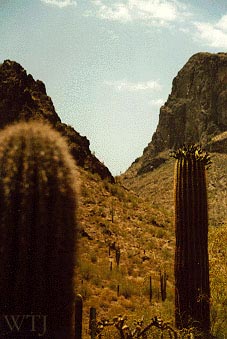 Into this volatile scene marched the
newly formed Confederate Army, whose formations had declared the entire New
Mexico Territory for the Confederacy on August 1, 1861. After securing the Rio
Grande Valley, the local Confederate commander dispatched Captain Sherrod
Hunter to Tucson, which he occupied on February 28, 1862 after a freezing
winter march. With its new garrison of 75 confederates, Tucson was now the
furthest point west in the Confederate Empire. They enjoyed the earnest support
of the local civilians, as long as they and their brethren helped to keep the
Indians suppressed, a task which drew considerable manpower away from the tiny
Confederate force. Into this volatile scene marched the
newly formed Confederate Army, whose formations had declared the entire New
Mexico Territory for the Confederacy on August 1, 1861. After securing the Rio
Grande Valley, the local Confederate commander dispatched Captain Sherrod
Hunter to Tucson, which he occupied on February 28, 1862 after a freezing
winter march. With its new garrison of 75 confederates, Tucson was now the
furthest point west in the Confederate Empire. They enjoyed the earnest support
of the local civilians, as long as they and their brethren helped to keep the
Indians suppressed, a task which drew considerable manpower away from the tiny
Confederate force.
The Union reacted quickly to the Confederate seizure
of the Southwestern Territories. Indeed, these events turned out to represent
the most complete takeover of Union territory the Confederacy managed during
its existence. Once the Confederate threat in California subsided¹ a small
force of roughly 1,400 troops under Brigadier General James H. Carleton was
dispatched from Fort Yuma to march on Tucson, hundreds of miles across the
Sonoran desert. Hearing word of Carleton's approach, Hunter pushed north out of
Tucson to the Gila River, encountering his first Union troops when the leading
detachment of California cavalry blundered into Hunter's men as they captured a
flour mill. After interring the Union cavalrymen and giving the flour to the
local Indians, Hunter returned to Tucson, first dispatching a small party of
Confederate cavalry to ride west along the stage road, burning hay which had
been left piled for the approaching Union troops. This party of rebels rode to
within 80 miles of Fort Yuma, finally stopping when they encountered the first
Union pickets, whom they drove off, wounding one. This little known skirmish
must have been the true "westernmost fight" of the Civil War!
| Northwest view |
 |
By early April, the California Column had reached an
area near present day Casa Grande, Arizona. From there, they dispatched a group
of scouts to reconnoiter the remainder of the route into Tucson. It was this
detachment of the First California Cavalry which ran into Hunter's men at
Picacho Pass on April 15. Hunter's strong detachment of pickets had occupied
ambush positions up on the rocky slopes of Picacho Peak, from which they
commanded a wide view of the stage road. Contrary to popular belief, the two
sides did not stumble upon each other by accident. The Confederates were
waiting in ambush, and only part of the Union cavalry troopers entered the pass
via the stage road. The position itself was so obviously an ambush point, that
the approaching Californians had split in two, sending part of their force to
circle the dangerous position as a precaution.
These precautions were
justified, because at 2 P.M., the Union cavalrymen entering the pass were fired
upon by Hunter's waiting men. Two Union troopers were injured, and the rest
went to the ground in disorder. At this time, the other Union force came up on
the flank of the Confederate skirmish line, capturing three of Hunter's men.
Encouraged by this victory, Union Lieutenant James Barrett waved his men
forward against the remaining Confederate cavalry troopers, who laid down heavy
fire, killing and wounding four more Union soldiers, including the young
lieutenant. After withdrawing and regrouping, the Union cavalry continued
trading shots with the Confederates until late afternoon, when they withdrew
and slowly returned to the main body to the north.
| North view |
 |
The "battle" at Picacho Pass may only have been a tiny
skirmish compared to the great conflagrations in the east, but to the men
killed and wounded there it was the Civil War. As a microcosm of the
greater war, local Confederate successes could not change the strategic
realities of the situation. Sherrod Hunter's Confederates continued to be
outnumbered, and they were too far from the main Confederate army on the Rio
Grande to receive regular supply or reinforcement. Carleton's California troops
finally arrived in Tucson, only to discover that Hunter had evacuated. The
retreat itself became well known in western lore, and Hunter's east-bound
troops were attacked repeatedly by Apaches based in the Chiricahua Mountains.
The Confederates even armed their Union prisoners as the march became a fight
for survival. The tired Confederates arrived on the Rio Grande River on May 27,
1862, bringing the Confederate invasion of Arizona to an end.
| Arizona Pioneers Historical Society - Southern Pacific
plaque |
 |
Visiting Picacho Peak
Anyone
who has driven between Tucson and Phoenix will know about Picacho Peak. It is a
major landmark in that part of the Sonoran Desert and can be seen from Casa
Grande to Northern Tucson. The peak itself is the eroded remnant of a volcanic
plug, which explains the solid stone walls which tower above Interstate Highway
10. At the peak there is an off-ramp which leads to commercial businesses at
the base of the mountain. The same ramp passes the historic site entrance,
where there is a small booth staffed by park rangers. The site itself is rather
small, and can be visited in a short but pleasant break from what is probably
the middle of a very long desert drive. Certainly your lunch break will be more
pleasant than any had by the gentlemen who were forced to spend weeks at a time
out in this area. Potential visitors from outside the Southwest should be
warned that summer temperatures easily exceed 110 degrees F (43 degrees C) and
that travellers should always carry several liters of extra water when
traveling across the desert.
¹ - At the beginning of the Civil War, California was
not an obvious member of the Union. The senior Army commander in California was
Albert Sydney Johnston, a Southerner. Also, many secessionist groups throughout
the state appealed to the local Hispanic population in their push for
secession. Only when Johnston resigned and headed east without surrendering
California to the Confederacy did the Union Government there begin to breathe
more easily. Even then it took a while for the situation to settle. |



)
)
)