On December 3, a warning was sent by OPNAV to Kimmel's
Pearl Harbor command (CinCPAC) warning: "...categoric and urgent instructions
were sent yesterday to Japanese diplomatic and consular posts at Hong Kong,
Singapore, Batavia, Manila, Washington and London to destroy most of their
codes and ciphers at once and to burn all other important confidential and
secret documents." War was considered to be imminent. A large Japanese
transport fleet was steaming toward Southeast Asia. Other Japanese fleet units
had left Japan and it appeared that the entire Japanese Imperial Navy was
deploying.
By this time American Vice Admiral William "Bull" Halsey was
taking the aircraft carrier Enterprise out to Wake to deliver a squadron
of Marine fighters in place of the withdrawn army aircraft which were being
kept on Oahu. He had departed Pearl Harbor on November 28 in the company of
several battleships, apparently headed out on routine maneuvers (his presence
at Pearl had indeed been noted by officials from the Japanese consulate in
Honolulu). As soon as he reached the open sea, he sent the battleships to their
usual exercise area and headed west with a heavy escort of cruisers and
destroyers. Once clear of the battleships, he issued Battle Order Number One,
which read: "The Enterprise is now operating under war conditions..."
Enterprise maintained radio silence for the rest of her voyage, and flew
fully armed combat air patrols and search patterns out to 200 miles. His own
feelings were that his carrier would be at war by the time he returned to
Pearl.
He was correct.
Ironically, Kimmel preferred to keep
the Pacific Fleet's battleships in harbor due to the unavailability of fleet
carriers to provide air cover. The carrier Enterprise was between Wake
and Oahu, the carrier Lexington was out near Midway and the carrier
Saratoga was on the west coast of the American mainland. Kimmel instead
left the battleships at Pearl Harbor, where they could be protected from enemy
air attack by large contingents of local army aircraft. Unfortunately Lt.
General Short had decided that sabotage was the most likely threat, and he had
ordered that all aircraft ammunition be locked away, and for aircraft to be
arrayed in neat rows for observation. The fact that the senior Navy and Army
commanders for the most important American installations in the Pacific
implemented somewhat conflicting policies apparently did not occur to anyone.
So as the hours ticked by, and the alerts and warnings piled up, the bulk of
the US Pacific Fleet remained in Pearl Harbor and took its usual weekend
off.
By 0330 on December 7, 1941, pilots on board the Japanese
carriers began to wake up from fitful sleep. Throughout the next 90 minutes the
men slowly arose and prepared for their mission. Fuchida found Lt. Commander
Shigeharu Murata, leader of the torpedo
The Politics of
Surprise
The Japanese attack on Pearl Harbor has often been referred
to as a surprise attack. In reality, the Japanese opening of war on the United
States, Great Britain and Holland, was not even remotely surprising to Allied
high command. The entire Japanese Fleet was known to be deploying for war, the
Dutch had already activated their war plan for the East Indies, and the
American government knew the exact time of Japan's deadline. Ironically, the
American government had applauded Japan's surprise attack on the Russian Fleet
at Port Arthur in 1904. Despite criticism from other countries at the time,
Great Britain and the United States heaped accolades on the Japanese for
showing "pluck" and "ingenuity" in their opening attacks against Russia's main
Pacific anchorage. Had the American administration in 1904 known that a similar
type of preemptive strike would be used against Hawaii within a few decades,
one wonders if they would have been so quick to congratulate that form of
success. |
bombers which would strike battleship row. Murata was
"vigorously" consuming breakfast and sang out to Fuchida "Good morning
commander, Honolulu sleeps!"
"How do you know?" Fuchida asked.
"The Honolulu radio plays soft music..." he responded, "...everything is
fine."
By 0615 the first fighters rose from the decks of the six
Japanese carriers. The first wave of 183 aircraft
were launched in record time; 15 minutes. At 0630 Fuchida flew south over
flagship carrier Akagi, followed by 40 Kate torpedo bombers under
command of Lt. Commander Murata, 51 dive bombers under command of Lt. Commander
Kakuichi Takahashi, 43 fighters under command of Lt. Commander Shigeru Itaya,
and immediately under Fuchida, 49 Kate high level bombers. Months of grueling
training, meticulous preparation and last minute labor was about to culminate
in an operation with the most dire consequences; an attack which essentially
committed the Imperial Navy to a war against the rest of the world. As they
approached the north shore of Oahu, two reconnaissance planes reported from
ahead; the Lahaina anchorage was empty, the American fleet was at Pearl Harbor,
resting quietly with no sign of an alert. Also, there were no American aircraft
carriers present. This last detail caused a pang of frustration with the
Japanese Commander. He had hoped to catch at least one or two carriers in the
harbor. Indeed, one-third of the available Japanese torpedo bombers approached
from the northwest specifically in the hope that they would be able to torpedo
any American carriers moored at their traditional places north of Ford Island. The first wave of 183 aircraft
were launched in record time; 15 minutes. At 0630 Fuchida flew south over
flagship carrier Akagi, followed by 40 Kate torpedo bombers under
command of Lt. Commander Murata, 51 dive bombers under command of Lt. Commander
Kakuichi Takahashi, 43 fighters under command of Lt. Commander Shigeru Itaya,
and immediately under Fuchida, 49 Kate high level bombers. Months of grueling
training, meticulous preparation and last minute labor was about to culminate
in an operation with the most dire consequences; an attack which essentially
committed the Imperial Navy to a war against the rest of the world. As they
approached the north shore of Oahu, two reconnaissance planes reported from
ahead; the Lahaina anchorage was empty, the American fleet was at Pearl Harbor,
resting quietly with no sign of an alert. Also, there were no American aircraft
carriers present. This last detail caused a pang of frustration with the
Japanese Commander. He had hoped to catch at least one or two carriers in the
harbor. Indeed, one-third of the available Japanese torpedo bombers approached
from the northwest specifically in the hope that they would be able to torpedo
any American carriers moored at their traditional places north of Ford Island.
Now the task was clear. Fuchida gave the signal to deploy for
full surprise attack. Had the Americans shown signs of being alert, the dive
bombers would have been ordered to attack first. With the American fleet
showing no sign of preparation, the torpedo bombers would attack first. Due to
a misunderstanding however, both dive bombers and torpedo bombers deployed for
their respective "attack first" positions. In frustration Fuchida realized that
his carefully coordinated plan was falling apart. But with a moment's
consideration, the total lack of American preparation sank in, and he realized
that it no longer mattered. As he took a last look at the US Fleet, he sent the
now famous radio message to all Japanese commands in the Pacific: "To ra, To
ra, To ra," complete surprise achieved.
The first aircraft to arrive
in the air over Oahu were Itaya's fighters, who fanned out over the island
directly from their deployment point north of Kahuku Point. Their original
purpose was to establish air superiority in case American fighters were fully
deployed. Their secondary task in case of complete surprise was to strafe
aircraft on the ground. First to be attacked by them was the Kaneohe Naval Air
Station on the east side of Oahu, which was attacked seven minutes before Pearl
Harbor. A sole fighter also flew as far south as Bellows field and quickly
strafed there before flying off. At Wheeler Field, the US Army base in central
Oahu, the fighters again were the first to arrive, and began strafing aircraft
several minutes before Takahashi's dive bombers arrived to join the fray.
Around the same time, more dive bombers made their first runs on the Army air
base at Hickam Field and the Navy field on Ford Island.
Within a few
minutes of these first bomb drops, the Nakajima "Kate" torpedo bombers of
Murata's command arrived to administer the worst damage of the day. Coasting
low over Pearl City and the Southeast Loch, they skimmed below rooftop level,
dropping their lethal "fish" into the water from point-blank range. The torpedo
attacks took longer than anticipated, because each pilot had been instructed
not to waste any torpedoes. In pursuit of this goal, many pilots made two and
even three attack runs before actually launching. This gave the effect that
there were far more attacking aircraft than there really were, and it also
enabled the American crewmen on the warships to react and begin shooting back.
Indeed, the speed with which the American ships reacted from a state of
complete repose was a shock to many of the Japanese pilots.
Because the
fleet was on a very low-level alert, there were even a few manned machine guns
at the very start of the attack. The battleship Nevada had some machine
guns in her fighting tops manned as part of the alert, and it was these guns
which distracted or shot down most of the torpedo planes who tried to attack
her. Only one torpedo hit Nevada, as compared to six which hit the
battleship West Virginia, four which hit Oklahoma, one which hit
Arizona and two which hit  California. Nevada was
fortunate in another way; she was the only capital ship present which had two
boilers fired instead of the usual one. Once the attack began, her senior
officers ordered two more boilers brought on-line in preparation to sortie. The
torpedo attack on Battleship Row was one of the most dramatic of the day. As
the torpedoes kept slamming home, Oklahoma slowly turned onto her side
and rolled into the bay. Soon only her glistening hull stuck out of the water
outboard of the Maryland. West Virginia also began to list
precariously, but quick counterflooding by a handful of crewmen quickly settled
the "WeeVee" onto the harbor bottom on an even keel. California. Nevada was
fortunate in another way; she was the only capital ship present which had two
boilers fired instead of the usual one. Once the attack began, her senior
officers ordered two more boilers brought on-line in preparation to sortie. The
torpedo attack on Battleship Row was one of the most dramatic of the day. As
the torpedoes kept slamming home, Oklahoma slowly turned onto her side
and rolled into the bay. Soon only her glistening hull stuck out of the water
outboard of the Maryland. West Virginia also began to list
precariously, but quick counterflooding by a handful of crewmen quickly settled
the "WeeVee" onto the harbor bottom on an even keel.
As the attack
progressed, Fuchida brought his high level bombers in over battleship row.
Their task was to drop heavy armor-piercing bombs designed to detonate the
powder magazines of the battleships, thereby preventing their repair. As with
the torpedo bombers, Fuchida's bombers had been instructed to make as many
passes as necessary in order to assure hits. It was only a matter of time then,
before some of these bombs found their way onto vital targets.
Tennessee, Maryland, West Virginia, Arizona and
Vestal (a repair ship moored next to the Arizona) were all hit in the
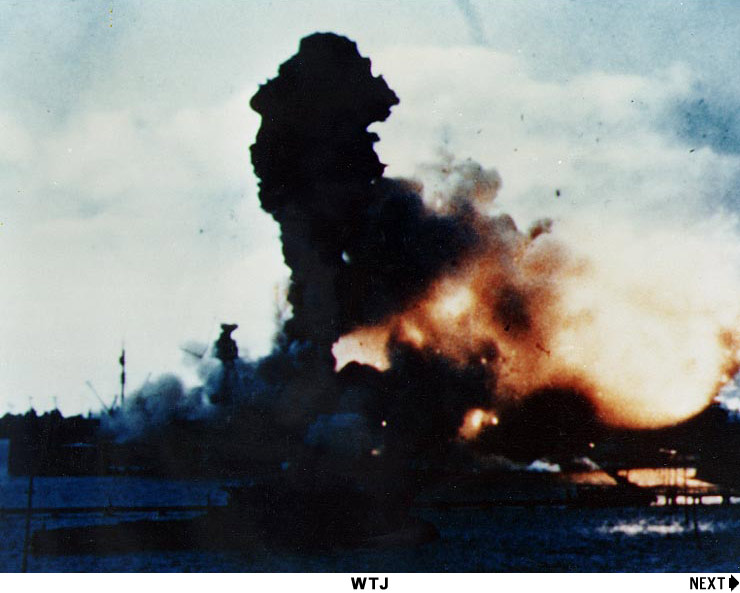
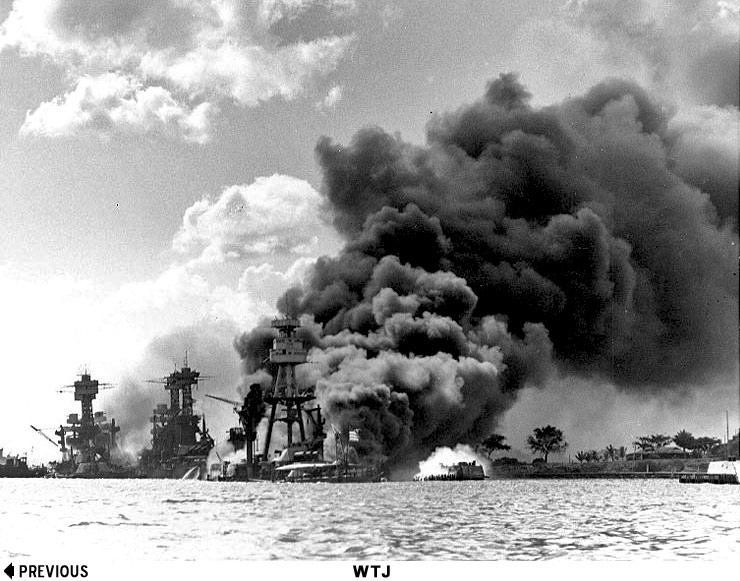
first few minutes. Arizona was worst hit, suffering at least five bomb
strikes. Somehow one of them detonated her main forward magazine, triggering a
titanic eruption of flame and smoke which shot into the sky . In just a few
seconds, half of all deaths suffered by Americans during the attack was
suffered by Arizona's crew as she split open and sank to the bottom of
the harbor.
The weight of Arizona's hull settling into the mud broke the main water
line running into Ford Island, crippling the fire-fighting equipment there.
Tennessee, which was already trapped by the flooded, burning West
Virginia now had to contend with a tide of burning oil pouring from
Arizona. The drifting sheets of burning oil were only kept at bay by
running Tennessee's giant screws slowly in reverse and by firing streams
of water from the ship's fire hoses directly off her stern (the streams of
water from the fire hoses are visible in some photographs taken during the
battle).
While the torpedo and high level bombers executed their
missions, dive bombers and fighters continued to hit their own assigned target
areas. For even though the attack seemed confusing to the untrained eye,
numerous American officers correctly observed the meticulous order with which
Japanese aircraft worked over their respective target zones. While good
visibility lasted, most of the aircraft made their attack runs in groups of
three to five planes and maintained excellent bombing discipline. Many strafing
aircraft approached at surprisingly low altitude, sometimes passing within a
yard of the ground in pursuit of their targets.
|