|
1944 During early 1944, Allied
forces continued the two main drives begun the previous year. In east Asia, the
Japanese prepared to launch their long-planned invasion of India while
simultaneously fending off a Chinese offensive. On February 4, American troops
stormed ashore on Kwajalein Atoll in the Central Pacific, and within weeks
leapfrogged to Eniwetok Atoll. The supporting U.S. carrier fleet then steamed
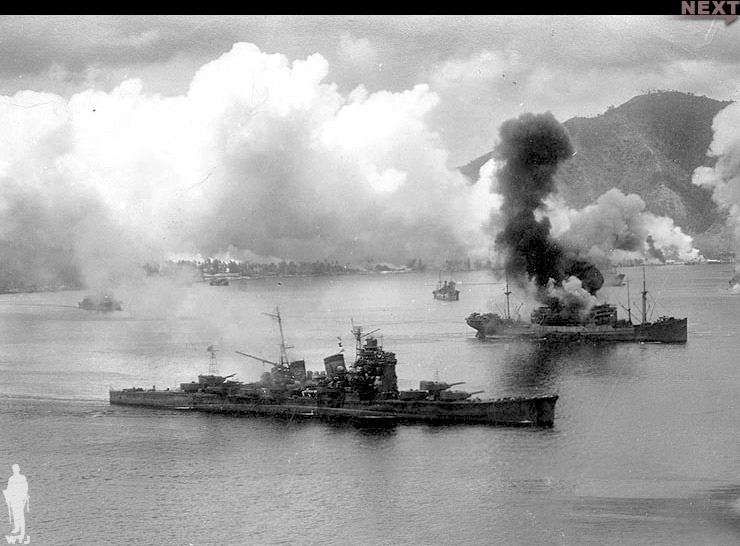
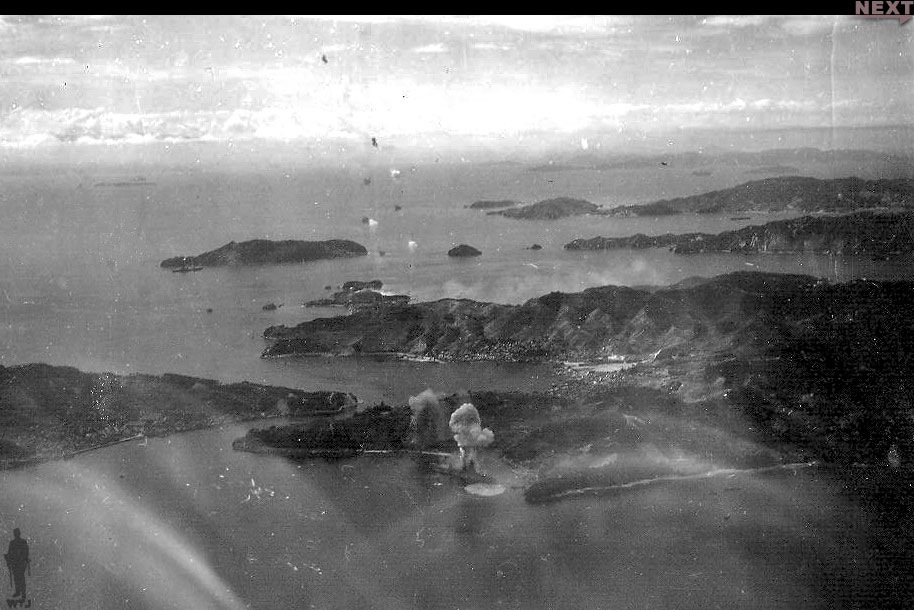
out to Japan's main fleet anchorage at Truk Atoll and devastated it in a series
of air raids which put that installation out of commission for the rest of the
war. During the second week in March, the twin Japanese campaigns against
eastern India and southern China finally materialized. During four weeks of
desperate fighting, British and Chinese forces blunted the Japanese thrusts and
slowly consolidated their positions. By early April, the campaign reached its
climax after which the defeated Japanese forces slowly withdrew. British forces
under General William Slim promptly counterattacked and turned their enemy's
withdrawal into a rout, killing and capturing two-thirds of the Japanese troops
and rendering many of the survivors unfit for further duty.
By the
middle of the year, the two Allied thrusts in the central and southern Pacific
were nearly ready to meet. In June American forces came ashore on Saipan in the
Marianas Island. Within days a Japanese carrier fleet responded, triggering the
famous Battle of the Philippine Sea, which was sardonically called "The
Marianas Turkey Shoot" by Americans because of the hundreds of Japanese
aircraft shot down at relatively little cost. As news spread of the debacle
which the Japanese were experiencing in Burma, the Allies reached their next
crucial decision; whether to separate Japan from her southern supply line by
retaking the Philippines or Formosa. This debate dated from early in the war,
when American General MacArthur promoted the idea of retaking the Philippines
as early as possible. American Admiral Nimitz favored capturing Formosa instead
of the Philippines. Eventually General MacArthur's proposal won out during a
series of meetings held in Hawaii. One stipulation was that Formosa's
substantial reserves of aircraft were to be neutralized before the Philippine
operation was begun.
As a preparation to the invasion of the
Philippines, American high command felt that the Palau island group 800
kilometers east of Mindinao needed to be secured, especially to prevent the
airfield on Peleliu from being used for flanking attacks against the U.S.
invasion fleet. Peleliu was captured during the course of a bloody amphibious
attack made by U.S. Marines in the face of unexpected new Japanese tactics that
emphasized defense in depth over their previous World War One style assault
tactics. Their older tactics had worked reasonably well when executed by crack
troops against enemies that operated on a similar tactical basis. But for many
standard Japanese line units pitted against heavily armed U.S. Marines who were
far more aggressive, the old style charge tactics resulted in long casualty
lists and failed operations.
By early October Admiral William
Halsey, commander of the main American carrier fleet, brought his ships within
striking range of Formosa and in a lightning air campaign his pilots drew much
of Japan's remaining air reserves into a calamitous air battle on a par with
 the "turkey shoot" of
the previous June. The few surviving Japanese pilots returned to their bases
with fantastic stories of American aircraft carriers and support ships sinking
by the dozens. In reality the Japanese aircraft inflicted little damage –
only a few U.S. ships were lost from service – and after being
reprovisioned, Halsey's fleet was still capable of putting over 1,000 aircraft
into the air. He did just that when the U.S. fleet withdrew from Formosan
waters and headed for the eastern Philippines. Japanese commanders in the
Philippines, assuming that the approaching American ships were survivors of the
Formosa battle, prepared to attack and sink the pitiful remnants of the their
enemy's fleet. Surprise was therefore complete when Halsey's full compliment of
naval aircraft made their appearance over the central Philippines and destroyed
much of what lay in their path. The Japanese were incredulous that the
Americans had such deep reserves as to be able to recover from supposed defeats
like those suffered off Formosa. the "turkey shoot" of
the previous June. The few surviving Japanese pilots returned to their bases
with fantastic stories of American aircraft carriers and support ships sinking
by the dozens. In reality the Japanese aircraft inflicted little damage –
only a few U.S. ships were lost from service – and after being
reprovisioned, Halsey's fleet was still capable of putting over 1,000 aircraft
into the air. He did just that when the U.S. fleet withdrew from Formosan
waters and headed for the eastern Philippines. Japanese commanders in the
Philippines, assuming that the approaching American ships were survivors of the
Formosa battle, prepared to attack and sink the pitiful remnants of the their
enemy's fleet. Surprise was therefore complete when Halsey's full compliment of
naval aircraft made their appearance over the central Philippines and destroyed
much of what lay in their path. The Japanese were incredulous that the
Americans had such deep reserves as to be able to recover from supposed defeats
like those suffered off Formosa.
On October 20, all doubts were cast
aside when reports arrived that Americans were landing on Leyte Island,
Philippines. Within days, the titanic Battle of Leyte was begun, and the
Japanese Imperial Navy – sailing from as far away as Singapore –
entered into its final great naval battle. By October 25, the finale of this
pivotal battle decided the fate of the Philippines and the Pacific war when
U.S. naval forces managed to destroy or turn away every Japanese column which
converged on the American landing zone. By the battle's end, Japanese vessels
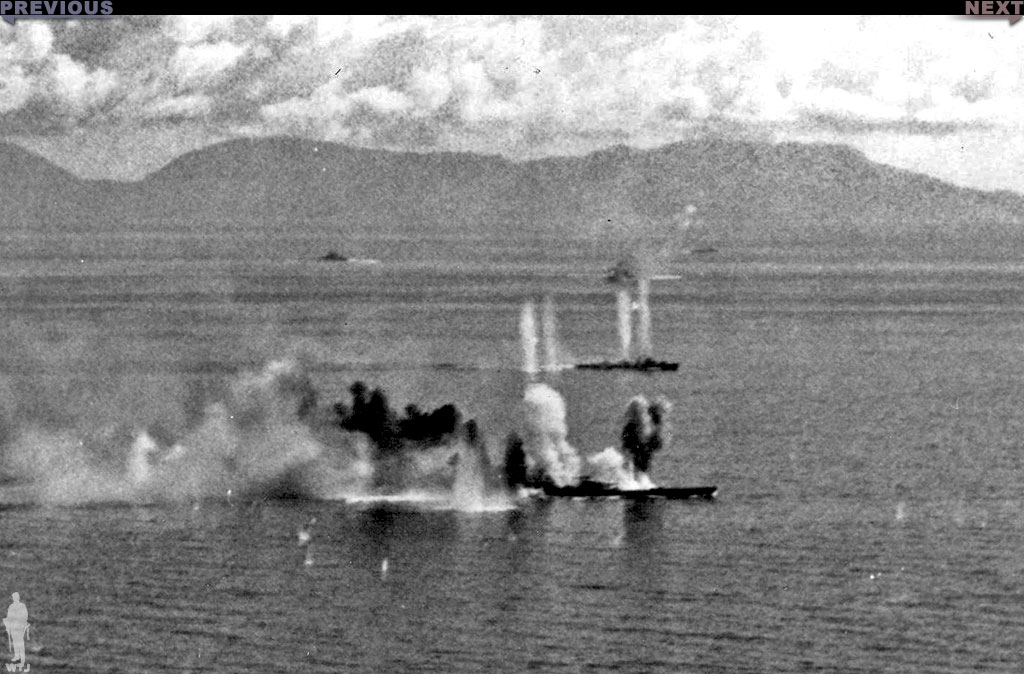
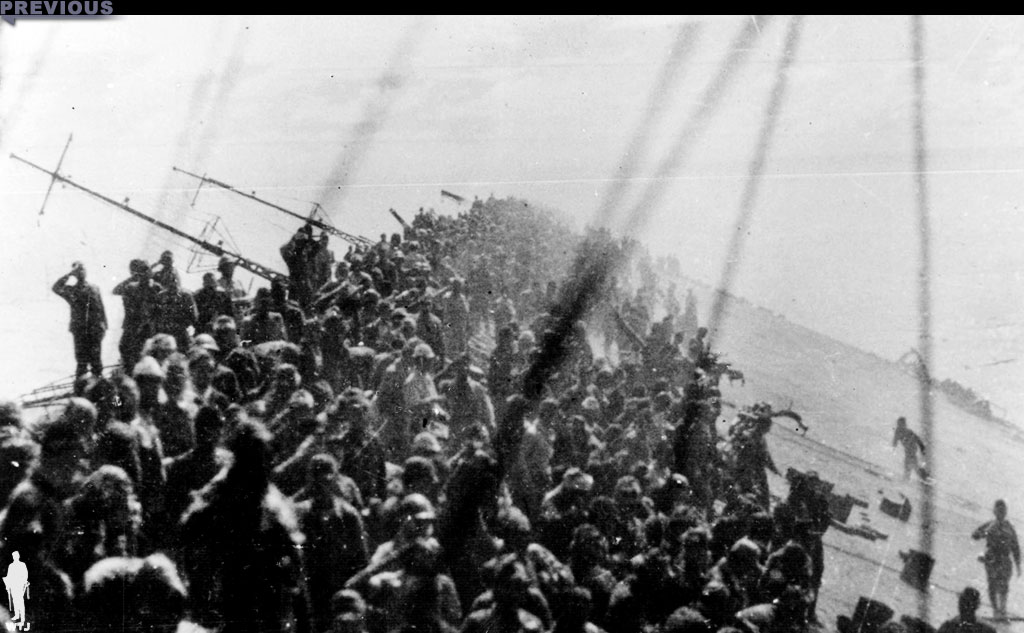
sunk included such venerable ships as the battleship Musashi (sistership of the
gigantic Yamato) and the aircraft carrier Zuikaku (veteran of the Pearl Harbor
attack). Total Japanese losses in tonnage and aircraft exceeded ten times that
of the American losses, a decisive defeat from which Japan would never recover.
In later years, Japanese officers were clear that for them, the turning
point of the war in the Pacific was the successful American landing at Leyte.
Still, the Japanese continued to fight back, employing kamikaze attacks with
increasing frequency. These new attacks became a fearsome weapon against which
Allied troops felt helpless. However Japan had a limited supply of enthusiastic
volunteers for these grim suicide missions and their numbers were never great
enough to sweep the Allied fleets from the seas in the manner hoped. By the
middle of November massive American air bases built in the Marianas Islands
filled with air fleets of brand new American B-29 bombers. These flying wonders
– so they were called – flew their first mission against Tokyo on
November 24.
1945 On January 9 of this last
year of war, American forces landed virtually unopposed on the main Philippine
island of Luzon. The defending Japanese commander – General Yamashita of
Malaya fame – correctly decided that defending a landing zone against the
Allies was hopeless in the face of massive American naval support. He instead
dug his overextended command into Luzon's three major mountainous zones and
forced his enemies to capture each piece of these fortified areas, tree by
tree, hill by hill. This long process allowed the Japanese to hold out
indefinitely within their mountain strongholds, although it also allowed much
of the remaining areas to come quickly under American control. The Japanese
naval commander at Manila went against Yamashita's wishes and along with his
17,000 naval infantry, he fought it out with the Americans. This of course
caused many thousands of civilians to be killed in the process.
On
February 19, the U.S. Marines entered into their bloodiest battle on the tiny
island of Iwo Jima, which lay half way between the Marianas Islands and the
Japanese mainland. At a cost of 5,000 American and 20,000 Japanese dead, Iwo
Jima was finally secured in time for the landings on Okinawa, which began on
April 1. Shortly before this American B-29 bombers started their famous fire
raids on Japanese industrial targets. The very nature of the firebombing caused
enormous civilian casualties, but this was considered thoroughly acceptable at
the time due to the brutal manner in which Japanese occupation forces were
known to have behaved, especially in China where an estimated 8,000,000 Chinese
civilians were killed. Also, it had been discovered that much of Japan's light
war industry was scattered through countless small shops dispersed amongst the
large suburban city districts. Entire cities had become industrial
targets.
In early April, the Japanese response to the Okinawa landings
arrived in the form of a colossal air-sea suicide campaign which involved no
less than the entire naval and army air fleets of southern Japan. Hundreds of
aircrews went into the fire along with Japan's prize vessel, the IJN Yamato,
the largest warship in the world. All of this however, failed in its goal of
destroying the U.S. fleet. In fact, although the number of damaged and sunk
Allied vessels was indeed great, none of the largest American aircraft carriers
were sunk, and many of those damaged were returned to service.
On
April 12 American President Franklin D. Roosevelt died and for a time the
morale of the Axis governments was buoyed by this news, hoping against hope
that it would allow some kind of political intervention. But that hope was
short lived. Allied business continued as before and in May the Japanese
government learned of Germany's surrender. This left Japan's forces alone
against the world as it attempted to defend an empire racked by bombing, famine
and supply shortages of every kind. By this time news came in from every front
telling of Japanese defeats: in Burma the British Army recaptured Rangoon and
on Okinawa the Americans cornered the remaining Japanese forces despite a
brutal campaign reminiscent of World War One.
Imperial Japan's armed
forces prepared for the inevitable invasion of the Japanese islands which they
believed must come. For many military commanders this was viewed as the
ultimate trump card for Japan's defense. The mobilization of the entire
Japanese population of 100 million – each of them willing to exchange
their life for that of an invader – and the million troops still in
Manchuria. It was hoped that these potent forces would allow the Japanese
government to continue the war for another year whilst negotiations continued
in a attempt to renew their non-aggression pact with the Soviet
Union.
Despite these hopes, the Japanese peace party which had been so
ardently suppressed during the early war again began to make its presence
known. The more persuasive of them put forth questions which were not easily
answered by army commanders who controlled much of the decision making. "What"
they asked "will happen if the Americans simply firebomb us for the next
several years? What then?" Nobody had answers to these questions, and the
knowledge that the Allies might consider options other than a costly invasion
allowed those in favor of peace to begin advancing their agendas.
War's End
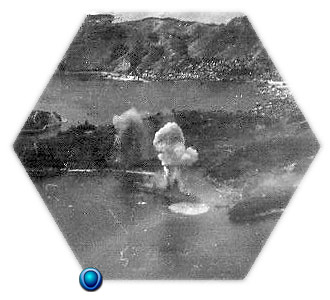 The agenda of the entire
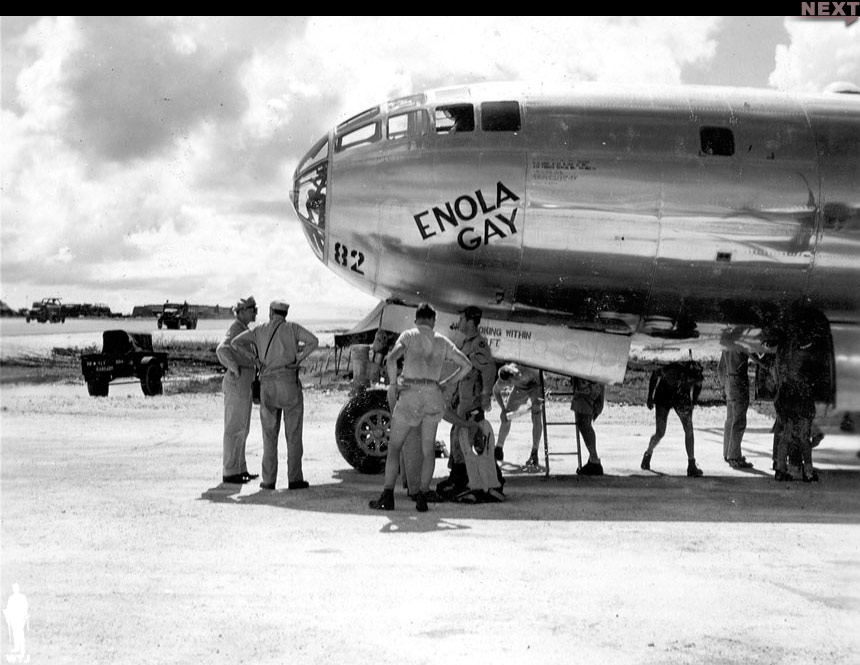
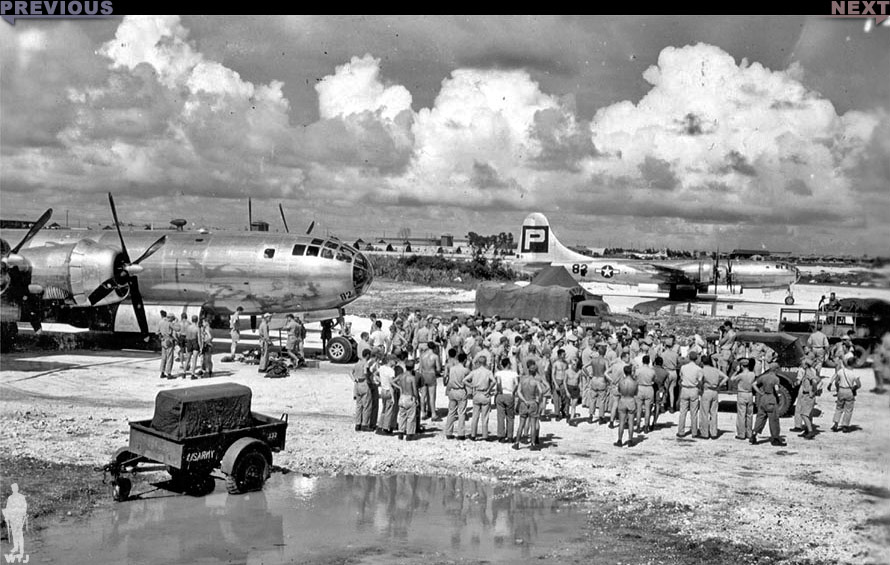
country was dramatically changed on the morning of August 6, when a lightly
escorted American B-29 bomber flew over the industrial city of Hiroshima and
dropped a powerful new weapon called an atomic bomb. The resulting shock, heat
wave and radiation killed tens of thousands of people who were in the downtown
area at the time. Although the casualties caused by the bombing were less than
those suffered during the Tokyo firebombings shortly before, the knowledge that
it was caused by a single bomb was sobering even to the most ardent
conservative. The density of casualties caused by the bomb was four times that
of firebombing and could be unleashed by a single aircraft. The agenda of the entire
country was dramatically changed on the morning of August 6, when a lightly
escorted American B-29 bomber flew over the industrial city of Hiroshima and
dropped a powerful new weapon called an atomic bomb. The resulting shock, heat
wave and radiation killed tens of thousands of people who were in the downtown
area at the time. Although the casualties caused by the bombing were less than
those suffered during the Tokyo firebombings shortly before, the knowledge that
it was caused by a single bomb was sobering even to the most ardent
conservative. The density of casualties caused by the bomb was four times that
of firebombing and could be unleashed by a single aircraft.
Keenly
aware that American aircraft could fly where they wished over all of Japan, the
country attempted to assess what had occurred over Hiroshima. Three days later
another atomic bomb was detonated over the city of Nagasaki. Again, tens of
thousands were killed, confirming the ability of the United States to
successfully build and deliver these powerful new weapons at-will. That same
day the Soviet Union opened a massive offensive against Japanese forces in
Manchuria where the Soviets used their better armored formations to devastating
effect, overrunning the frontline in advances that were difficult for imperial
high command to believe. Japanese forces opposing the Red Army began to lose
men by the hundreds of thousands with not nearly enough damage inflicted in
return to make up for their loss. Japan was losing control of the mainland.
The entry of Russia into the war and the twin bombings of Hiroshima and
Nagasaki spelled doom for Japan's trump card of national mobilization. Now the
United States could pummel Japanese civilization into extinction without even
setting foot on the home islands, and imperial army troops in China could do
nothing to stop it. Indeed the later seemed bound for extinction. All of this
undeniably bad news allowed those in favor of peace – including Japanese
Emperor Hirohito – to have their way and on August 15, 1945, the Emperor
announced to his nation that it would surrender "in order to save mankind" from
nuclear oblivion. So powerful was the Japanese military and so deep was their
conviction of ultimate victory or stalemate, even at this point the Emperor
barely convinced many officers to stand down and accept surrender. More than a
few committed suicide rather than accept the disgrace and others took days to
convince of the finality of the Imperial decision. In some areas there was
armed mutiny. The final surrender was signed on board the American battleship
Missouri in Tokyo Harbor, ushering in a long period of recovery for all of the
nations involved.
"Our navy has lost the war by "battling"
instead of "warring." This fatal confusion was due in my judgement to our
erroneous education. To point out what should have been the right education is
idle effort. Our navy is no more. The verdict was severe. In conclusion I wish
to mention just one thing. And that is that education is important, really very
important."
Masataka Chihaya
March, 1946
Epilogue World War
Two in Asia and the Pacific was fought over the largest area of any conflict in
history. Japanese submarines bombarded the California coast, and Japanese
aircraft carriers raided Allied harbors and shipping along the coast of India.
The expanse of land and sea which lay between these places encompasses half of
the planet, a testament to the determination of both sides of the conflict. The
country which suffered most during this harrowing time was China, who by war's
end counted over 13 million dead, most of them civilians. During the course of
their effort, Japan lost over two million dead, mostly military. After the war,
East Asia continued to face many long years of recovery, and in many cases,
post cold-war or colonial violence which continues to roil at the surface of
human affairs.
Over the long expanse of Pacific waters between Asia,
Australia and North America, the islands which came to fame during the war have
slowly drifted out of public consciousness. Places with odd names like
Guadalcanal, Tarawa and Siam were the center of the universe for a world at
war, and everyone talked of the latest news there. Little has changed in many
of these places since the war swept over them and much about the war has been
forgotten. Hopefully enough is remembered to prevent a repeat of the mistakes
and miscalculations that led to this tremendous catastrophe.
|